The International Armenian Literary Alliance, the National Association for Armenian Studies and Research, and the Krikor and Clara Zohrab Information Center will host Literary Lights 2025, our third annual reading series showcasing new works of literature by Armenian authors. Each event—held online or in-person—will feature a writer reading from their work, followed by a discussion with an interviewer and audience members.
Our launch event—featuring contributors and the editors of the recent Wasafiri issueArmenia(n)s—will take place on February 15th! Keep an eye the IALA website and socials for the exact dates of each event and Zoom links. Read along with the series by purchasing titles at IALA’s Bookshop storefront.
“Wasafiri: Armenia(n)s – Elevation” by Tatevik Ayvazyan and Naneh V Hovhannisyan
From poetry and fiction to thought-provoking book reviews, art, life writing and in-depth interviews, this landmark edition is a rich tapestry of modern Armenian voices. It offers readers a profound and eloquent exploration of the human condition through meditations on the Armenian language, culture, and identity. Featured contributors include award-winners such as Chris Bohjalian, Nancy Kricorian, and many more.
Returning to the fabular tone of Zabelle, her popular first novel, Kricorian conjures up the lost worlds and intergenerational traumas that haunt a family in permanent exile. Leavened with humor and imbued with the timelessness of a folktale, The Burning Heart of the World is a sweeping saga that takes readers on an epic journey from the mountains of Cilicia to contemporary New York City.
A thrilling collection of essays converging on themes of natural history, deep/queer ecology, philosophy of science, climate grief, and more-than-human belonging. Wide-ranging, richly observant, and full of surprise, Forest Euphoria: The Abounding Queerness of Nature will open your eyes and change how you look at the world around you.
In this deeply moving debut, a close-knit Armenian American family grapples with the aftermath of losing one of their own. Aram Mrjoian’s Waterline: A Novel explores the complex beauty of diaspora, the weight of inherited trauma, and the echoes of the Genocide on contemporary Armenian life.
With Nostalgia for the Future: New and Selected Poems, 1984-2023, award-winning poet Gregory Djanikian returns to the literary scene with a collection that spans and celebrates his prolific career.
To Say With Passion: Why Am I Here? by Tenny Arlen
Tenny Arlen’s book of posthumous Armenian poetry, Կիրքով ըսելու՝ ինչո՞ւ հոս եմ (ARI Literature Foundation, 2021) is among the first books of creative literature written in Armenian by an American-born author. For the most part written during the author’s years at UCLA (2011-2013), the poetry of Tenny Arlen represents not only a new phenomenon but a new voice in Modern Armenian literature. At the request of many, a bilingual edition of the book, featuring the author’s own English-language translations of her poetry, lightly edited by the poet’s brother, Dr. Jesse Arlen.
The poetry of Tenny Arlen (1991–2015) was recently featured in the LAdige Review, the home of “California Poets” an ongoing online anthology and interview series conceived in 2020 by David Garyan.
Featured alongside the work of other California poets are 10 poems by Tenny Arlen, 8 from her book Կիրքով ըսելու՝ ինչո՞ւ հոս եմ (To Say with Passion: Why Am I Here?) (Yerevan: ARI Literature Foundation, 2021). The poems from the book appear in Armenian with the author’s own English-language translations. Additionally, 2 previously unpublished poems in English appear here for the first time.
Following the poems is an interview with the late poet’s brother, Zohrab director Dr. Jesse Arlen, on Tenny’s life and work. You may read the poems and interview by following this link to LAdige Review.
The Zohrab Information Center is hosting a Գրաբար reading course, “Medieval Armenian Poetry,” on Mondays 2:00–4:00pm ET via Zoom from January 13th to March 31st. Those unable to attend live can have access to the course materials and recordings of the sessions by registering via the Zoom registration linked below.
The course will be taught by Dr. Jesse Arlen with poetic texts chosen from the rich treasury of medieval Armenian literature. Writers include the 8th-century female hymn composers Khosrovidukht Goghtnatsi and Sahakdukht Siwnetsi, as well as Anania of Narek and St. Gregory of Narek, Gregory Magistros, St. Nersess Shnorhali, and others.
It is recommended that participants already be familiar with the basics of Classical Armenian grammar or have reading and writing knowledge of Modern Armenian in order to benefit from the course.
To register for the course, click here. For questions about the course, send an email to: zohrabcenter@armeniandiocese.org.
On Thursday, January 16th at 7:00pm PT / 10:00pm ET, Dr. Jesse Arlen will give a presentation hosted by the Hamazkayin Western Region Literary Unit on St. Nersess Shnorhali and the recently published book by co-authors Jesse Arlen and Matthew Sarkisian Odes of St. Nersess the Graceful: Annotated Translation (New York: Tarkmaneal Press, 2024).
Please register for this online event, whose proceedings will take place primarily in Armenian, at this link.
The Zohrab Information Center is hosting a Գրաբար reading course, “Medieval Armenian Poetry,” on Mondays 2:00–4:00pm ET via Zoom from January 13th to March 31st. The course will be taught by Dr. Jesse Arlen with poetic texts chosen from the rich treasury of medieval Armenian literature.
It is recommended that participants already be familiar with the basics of Classical Armenian grammar or have reading and writing knowledge of Modern Armenian in order to benefit from the course.
To register for the course, click here. For questions about the course, send an email to: zohrabcenter@armeniandiocese.org.
An Early-Eighteenth-Century Hmayil (Armenian Prayer Scroll): Introduction, Facsimile, Transcription and Annotated Translation (New York, NY: Tarkmaneal Press, 2024), by Matthew J. Sarkisian, edited and with a foreword by Jesse S. Arlen is now available in print in both hardcover and paperback formats.
The volume is the first in the Krikor and Clara Zohrab Information Center’s Sources from the Armenian Christian Tradition series and was previously released online in digital format in 2022. The revised print edition features some updates and corrections and full-color photographs.
Cover of Matthew J. Sarkisian. An Early-Eighteenth-Century Hmayil (Armenian Prayer Scroll): Introduction, Facsimile, Transcription and Annotated Translation. Edited and with a Foreword by Jesse S. Arlen. Sources from the Armenian Christian Tradition, volume 1. New York, NY: Tarkmaneal Press, 2024 (revised print edition)
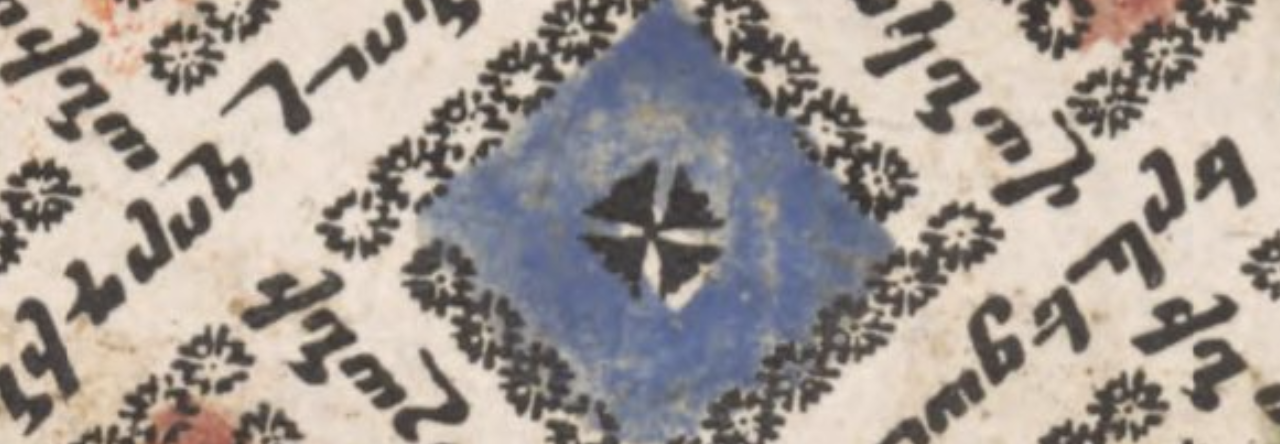
A hmayil is a handwritten or printed scroll containing prayers, supplications, Psalms, Gospel passages, hymns, and incantations. These scrolls, often richly illustrated, were a popular medium used for protection against maladies and other evils during the early modern period and were often carried or worn like a talisman. In this volume, Matthew J. Sarkisian and editor Jesse S. Arlen provide the Armenian text and an English translation of one such scroll printed in Constantinople in 1727. Together with facsimile images of the hmayil, this volume offers the reader an experience similar to unrolling and reading the original scroll. The translation is accompanied by an introduction, extensive annotation, and appendices, which bring to light the Scriptural and theological background as well as the folk and traditional characteristics of the hmayil’s texts and illustrations, making this fascinating artifact accessible to the general reader in the twenty-first century.
The publication of this volume was supported by a generous grant from Souren A. Israelyan. The book is available to purchase on Amazon.
The Zohrab Center warmly invites you to our next in-person event, a public lecture by Tamar Purut, entitled, “Frik’s Relatable Freakshow: Echoes of Faith and Endurance for Confronting Today’s Geopolitical Turmoil.” This interactive lecture will take place in Yerevan Room of the Diocesan Center on Thursday, December 12th at 7:00pm. All are welcome to attend.
Tamar Purut is a first-generation Armenian-American born and raised in New Jersey. She holds a Bachelor’s Degree in Philosophy and Political Science from Seton Hall University, a Master’s Degree in International Security from University College London, and, most recently, a postgraduate degree in Classical Armenian Studies from the University of Oxford. She is seasoned in operating anti-money laundering and compliance programs at first-tier global financial institutions and is presently an Assistant Vice President at BHI Bank. Tamar wishes to continue serving her compatriots while inspiring further discourse on what it means to be an Armenian in the diaspora while remembering and honoring her roots.
Description of Lecture: This talk will explore the life and legacy of Frik, one of Armenia’s most influential medieval poets. Through his eloquent verse, Frik captured the struggles of his time, blending profound theological reflection with poignant political commentary. His work delves into the complex relationship between faith, identity, and the ever-shifting contours of power. The presentation will examine how Frik’s writings, though rooted in the medieval Armenian experience, continue to resonate with contemporary geopolitical conflicts and questions of faith. Tamar will discuss how his reflections on the human condition and the search for divine justice offer timeless insights into the challenges we face today. This will be an opportunity to (re)discover how Frik’s poetic vision still echoes in modern debates about religion, conflict, and the pursuit of meaning in an increasingly fragmented world.
The personal papers of Dolores Zohrab Liebmann, foundress and benefactress of the Zohrab Information Center, have been processed, and the collection is now available for the interested public to view and research at the Zohrab Center. It was the first such archival special collection processed by the Center (in the late winter of 2022 and spring of 2023), serving as a model for the subsequent special collections of unique, mostly unpublished materials now available for viewing and research. Under the guidance and with the collaboration of Center director Dr. Jesse S. Arlen, the papers were processed by Dn. Andrew Kayaian, former long-time employee of the Center who is now the librarian of St. Vladimir’s Seminary and is currently a graduate student at Simmons University pursuing a Library and Information Science degree.
Mrs. Dolores Liebmann née Zohrab was born in Istanbul on January 13, 1896 (recorded in the certificate as January 2, 1896, according to the Julian/Old Style Calendar).
Sealed document from the Armenian Patriarchate of Istanbul (“Stanboul” in Armenian), primarily written in French, giving Dolores’ birth information and details surrounding her baptism of July 23, 1896 (August 3, 1896 according to the Gregorian Calendar/New Style).
She was one of four children, along with her sister Hermine and brothers Aram and Leo, of Krikor Zohrab, the famous Ottoman-Armenian community leader, parliamentarian, lawyer, and writer, and his wife Clara Zohrab née Yazidjian.
Photograph of Krikor ZohrabDolores’ mother Clara (standing, center), Dolores herself (standing on the right, on Clara’s left side), and Dolores’ sister and brothers.
With the initiation of the Young Turks’ genocidal policies in 1915, Dolores was a witness to Krikor’s arrest and removal by the Ottoman government. Her brothers were attending school in France at the time. Clara Zohrab escaped with Dolores and her sister Hermine from Istanbul to Paris, France through Austria to join the boys in order to avoid a similar fate in Turkey. Dolores and Hermine remained in Paris until the death of their mother some years later, after which Dolores moved to Romania where one of the brothers was living at the time.
In Romania, Dolores Zohrab met and eventually married Henry L. (Leopold) Liebmann (1871-1950) in 1932; Dolores was Henry’s second wife. Henry Liebmann was a member and heir of the Liebmann family in New York, which had made its fortune from their brewery business in Brooklyn. The brewery was well known in the New York metropolitan area and the larger East Coast of the United States as the producer of the popular Rheingold Beer.
Front page of the Liebmann’s marriage license.
Open interior of the marriage certificate. Notice that the certificate asks for their religious backgrounds: it lists Henry’s Jewish roots as “Mozaica” and Dolores’ Armenian Church roots as “Gregoriana,” (‘Gregorian’), a not uncommon designation for the Armenian Church.
After their marriage, Dolores and Henry returned to America, residing in New York City, which she would call home for the rest of her life. The married couple would often vacation around Lake Tahoe in California and take cruises.
Henry Liebmann died in 1950, leaving his estate to Dolores. For the next forty years, she was a perennial name in and among high society in New York and the wider American Armenian community. Besides the various official papers, the collection of her papers also contains many letters and other correspondence. From these one sees that Dolores was well connected and in contact with many prominent Armenians in America of the twentieth century.
Dolores in the company of Eastern Diocese Primate Archbishop Torkom Mannoogian, benefactors Haig and Alice Kavookjian, and singer Charles Aznavour.
Dolores in the company of the late academic/educator/historian/administrator Vartan Gregorian and scholar S. Peter Cowe, among others.
For example, the collection contains Dolores’ correspondence with the Eastern Diocese regarding the publication of a book of selections of her father Krikor Zohrab’s writings (Voice of Conscience), some correspondence with entrepreneur and philanthropist Alex Manoogian, and materials concerning Dolores’ patronage of Armenian studies at Columbia University.
She appears to have been a close friend of famed Armenian Studies scholar and art historian Sirarpie Der Nersessian and her sister Arax Der Nersessian.
An air mail letter between Dolores (“Ma Cherie Dolly”) and Sirarpie, one of many pieces of air mail.
Taking inspiration from her upbringing, she was a major patroness of Armenian culture and education, especially in America but also throughout the world. The Mesrob School in France sent her a letter of gratitude for her patronage; the Armenian Museum of Literature sent a thank you letter (image below) for her donation of Krikor Zohrab’s papers.
Thank you letter from the Armenian Museum of Literature for the donation of Krikor Zohrab’s papers
Toward the end of her life, Dolores founded the Krikor and Clara Zohrab Information Center to function as a major hub of information collection and distribution among the Armenian American community. There are some materials from the opening of the Center on November 17, 1987, as well as photographs showing Dolores in the company of Catholicos Vasken I and then-Primate Archbishop Torkom Manoogian.
A cropped photo of the photo collage in the Zohrab Center reading room: the center image in the top row shows the 1987 opening ceremony with Dolores, Catholicos Vasken, and Archbishop Torkom. Atop the frame is Dolores’ cane.
Front page of an informational pamphlet about the Zohrab Center.
Thank you letter to Dolores from her law firm in gratitude for the “brochure” she sent to them connected to the Center’s opening.
Cover of the program published for the opening of the Center in 1987.
Dolores was eventually awarded the St. Nerses Shnorhali Medal in recognition of her philanthropy and dedication to the Armenian community by Catholicos Vasken, the encyclical for which hangs in the reading room of the Center.
The encyclical for Dolores’ reception of the St. Nerses Shnorhali Medal in the Zohrab Center reading room.
The St. Nerses Shnorhali medal
Dolores Zohrab Liebmann passed away in 1991; in her will, she established an endowment to sustain the Zohrab Information Center. Among other philanthropic endeavors, she also established The Dolores Zohrab Liebmann Fund, which supports the publication of books in Armenian studies and provides funding for graduate studies. This collection chronicles the extraordinary life of a great lady in the twentieth century Armenian community and is a major resource for all those interested in twentieth-century Armenian life, especially in America but also throughout the world.
Zohrab Center director, Dr. Jesse S. Arlen, will be on the road to present talks in the coming days. On Monday, October 28th at Catholic University of America in Washington, D.C., he will present on the rich manuscript heritage of Grner monastery in Cilicia under Bishop John (Yovhannes Arkayeghbayr), brother of King Hetum I.
Then on November 7th at the Western Diocese of the Armenian Church of America he will participate in a program put together by the Western Diocese and the UCLA Narekatsi Chair of Armenian Studies, Prof. Peter Cowe, entitled “An Evening Honoring the Legacy of St. Nerses Shnorhali,” a literary, musical, artistic, and visual celebration of the saint’s liturgical music, including the Odes (տաղք), newly translated to English by Dr. Arlen and Matthew J. Sarkisian.
Both programs are open to the public.
While in Washington, D.C., Dr. Arlen presented today on medieval Armenian colophons at the Armenian Relief Society Norian “Youth Connect” Program at the Library of Congress and Johns Hopkins School of Advanced International Studies, organized by Dr. Khatchig Mouradian.
Honoring the legacy of the eponymous intellectual of the Center, a bibliography of writer, lawyer, and parlamentarian, Krikor Zohrab, who also became victim to the Armenian Genocide, has been included under the biography page of our website.
Prepared by our very own Arthur Ipek back in 2015, and recently updated, it includes works published by Zohrab in Armenian, in addition to works about his personal life and literary legacy and translations into English, French, and Turkish. Although the bibliography has been prepared in Armenian, non-Armenian works are also noted.
The bibliography is freely available to download in .pdf and .docx format.
Photograph of Krikor Zohrab, Box 3, Folder 17, Dolores Zohrab Liebmann Collection (Collection 001). ZIC Special Collections, Krikor and Clara Zohrab Information Center. Diocese of the Armenian Church of America (Eastern), New York, NY.