On Wednesday, October 27th, the Zohrab Center’s Lily E. Jelalian intern Luiza Ghazaryan (NYU ’26) presented original research at the NYU Martin Luther King, Jr. Scholars Program Research Symposium, entitled “Handwritten Memory: Manuscripts and Literary Journals of Armenian Migrants.”
Luiza Ghazaryan with her poster, entitled “Handwritten Memory: Manuscripts and Literary Journals of Armenian Migrants”
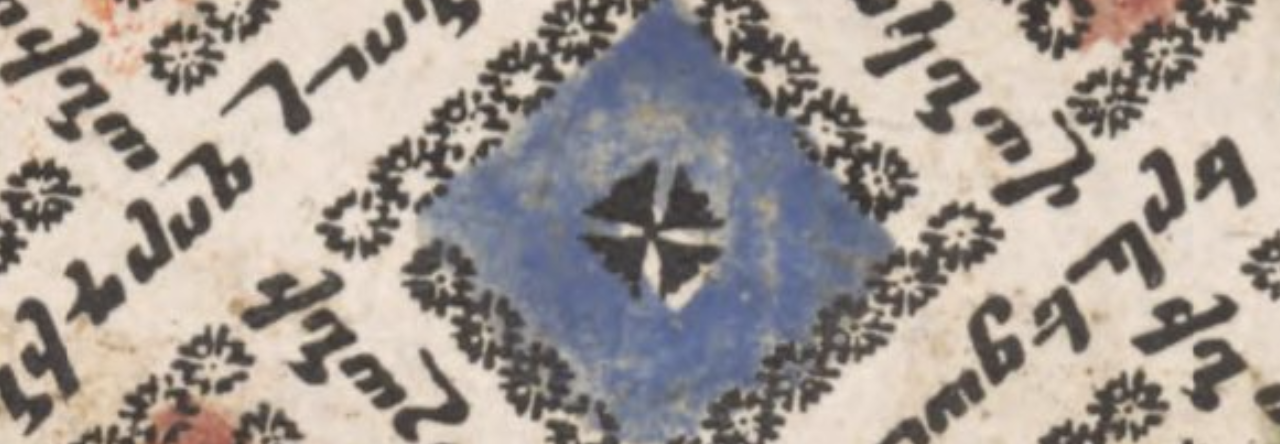
Conducted under the supervision of Zohrab Center director, Dr. Jesse S. Arlen, and Zohrab Center special projects coordinator and research associate, Arthur Ipek, Luiza surveyed and described 9 manuscript journals and diaries of Ottoman Armenians from the late 19th and early 20th centuries kept in the special collections of the Zohrab Center library.
Luiza chose one such handwritten journal to make the focus of her poster presentation, a collection of love poems penned by Harutyun G. Iskenderian between 1905–1906.
Luiza Ghazaryan’s poster based on her research and translation of the poems of Harutyun G. Iskenderian
Born around 1887 in Everek (Kayseri [Կեսարիա, Caesarea], Turkey), Harutyun was a freshman at St. Paul’s Institute in Tarsus during the 1905-1906 academic year. During this time, he composed an 87-page manuscript of love poems in Western Armenian, dedicated to his beloved Ms. Marine Dadourian. Luiza translated these poems from Western Armenian into English and situated them within the context of late Ottoman Armenian life and education in the provinces.
“Through my translations of Haroutune Iskenderian’s poetry, I have revealed the ways in which he conveyed sentimental expressions of wisdom, love, and devotion. Immersing myself in the author’s writings and their historical context—that is, Iskenderian’s Kayseri—made me realize how communities and educational institutions more than a century ago fostered an appreciation for literature in the hearts of students. To help me better understand this context and the author’s identity, I also made use of archival material, with school reports, photographs, and historically relevant correspondences with the US that dealt with the liminal space between life in the provinces and the Armenian Genocide,” said Luiza.
Luiza Ghazaryan is a Biology major at NYU (class of 2026), who is also pursuing minors in Creative Writing and Chemistry. She began working at the Zohrab Center in summer 2023, as a Lily E. Jelalian summer intern, a program generously funded by Dean Shahinian and has continued at the Zohrab Center since that time.
We congratulate Luiza on her research and achievements!
The contents of the book relate directly to the history of the Diocese of the Armenian Church and the Armenian American community of New York and the East Coast in general, and much of the research for the book was conducted in the Zohrab Center itself, which is warmly acknowledged by Dr. Alexander at the outset of the book.
Table of Contents
List of Figures
List of Maps
AcknowledgmentsIntroduction1. The Contested Homeland: World War I and the Genocide
2. Years of Adjustment: Armenian Americans in the 1920s
3. The Tourian Affair: Contested Memories and an Archbishop’s Murder
4. “To Supply Armenia with Architects”: The Coming-of-Age of the American-Born Generations
5. Fighting on Many Fronts: World War II and Its Aftermath
6. The Armenian Americans’ Cold War
7. A House of God Divided: The Formalization of the Church Split
8. The Power of a Word: Naming and Claiming the Genocide
The contents of the book relate directly to the history of the Diocese of the Armenian Church and the Armenian American community of New York and the East Coast in general, and much of the research for the book was conducted in the Zohrab Center itself, which is warmly acknowledged by Dr. Alexander at the outset of the book.
Table of Contents
List of Figures
List of Maps
Acknowledgments
Introduction
1. The Contested Homeland: World War I and the Genocide
2. Years of Adjustment: Armenian Americans in the 1920s
3. The Tourian Affair: Contested Memories and an Archbishop’s Murder
4. “To Supply Armenia with Architects”: The Coming-of-Age of the American-Born Generations
5. Fighting on Many Fronts: World War II and Its Aftermath
6. The Armenian Americans’ Cold War
7. A House of God Divided: The Formalization of the Church Split
8. The Power of a Word: Naming and Claiming the Genocide
The Zohrab Center is pleased to share that the third annual Grace and Paul Shahinian Armenian Christian Art and Culture Lecture, established through the generosity of Mr. Dean Shahinian, will take place on March 27th in Washington, D.C. Please find the details below:
Lecture Title: “When Things Fall Apart: Disentangling Christian-Muslim Relations in Medieval Armenia”
Speaker: Prof. Sergio La Porta
Place: Heritage Hall in O’Connell Hall at the Catholic University of America in Washington, D.C.
Date and Time: March 27 at 5 pm
Lecture open and free to the public. Reception to follow
Dr. Sergio La Porta is currently the Acting Dean of the Kremen School of Education and Human Development at California State University, Fresno. Prior to assuming this role, he was the Associate Dean of the College of Arts and Humanities and the Haig and Isabel Berberian Professor of Armenian Studies. His most recent book publication, co-authored with Dr. Alison Vacca, is entitled, An Armenian Futūḥ Narrative: Łewond’s Eighth-Century History of the Caliphate (Chicago: Institute for the Study of Ancient Cultures, 2024). In addition, Dr. La Porta has published on the Armenian commentaries on the works attributed to Dionysius the Areopagite, and numerous articles on medieval Armenian intellectual history and cultural interactions with the Islamicate, Byzantine, and Latinate worlds.
The Byzantine annexation of Armenia in the eleventh century followed by the Seljuk invasions brought dramatic political and demographic changes to the region. Nonetheless, a modus vivendi between Christians and Muslims in Armenia was established by the end of that century. This condition of “rough tolerance,” to borrow a phrase used by MacEvitt in the context of the Crusades, lasted until the second half of the twelfth century. This talk will argue that contemporary Armenian stories of martyrdom both shed light on the previous state of affairs and document the disintegration of intercommunal relations during this period.
Past Lectures in the Grace and Paul Shahinian Armenian Christian Art and Culture Lecture Series:
(1) The inaugural lecture was on March 23, 2023 at 5 pm (Heritage Hall, The Catholic University of America). The speaker was Prof. Christina Maranci (Harvard University) who spoke on the topic “Armenia and the World in Art and Text.” For a video of the lecture, see https://www.youtube.com/watch?v=SBccQFf1Tmg&t=15s
(2) On March 21, 2024 we hosted the Second Annual “The Grace and Paul Shahinian Armenian Christian Art and Culture Lecture Series.” The speaker was Prof. Zara Pogossian (University of Florence) who spoke on the topic “Women and Power in Medieval Armenia: Beyond Local Dynasties and Eurasian Empires.” For a video of the lecture, see https://www.youtube.com/watch?v=R-Uyg8VUfzc&t=212s
On Monday, February 3rd, at 7:00pm, Dr. Nora Lessersohn will deliver an illustrated lecture entitled, “The Twain Shall Meet: Armenian-American Images from the Civil War Era.”
All are welcome to attend this public event, featuring the life and work of Christopher Oscanyan, the first Armenian New Yorker.
Dr. Nora Lessersohn is the Nikit and Eleanora Ordjanian Visiting Professor of Armenian Studies in the Department of MESAAS at Columbia University. She is a historian of the Armenian-American diaspora and U.S.-Middle East relations, broadly conceived. She earned her PhD in History from University College London in 2023, supported by a Calouste Gulbenkian Armenian Studies Scholarship. In 2021-22, she was a Predoctoral Fellow at the Smithsonian American Art Museum and the National Museum of American History. She earned her AB in the Study of Religion at Harvard College and her AM in Middle Eastern Studies at Harvard University, where she was also a Visiting Fellow in 2023-2024. Dr. Lessersohn has published articles on the memoir of her great-grandfather, Hovhannes Cherishian, and is now preparing a manuscript on Chistopher Oscanyan and Ottoman-American cultural diplomacy across the 19th century (and especially in Civil War era New York City).
Linda Smith, an archival intern at the Zohrab Center who is a graduate student in New York University’s Moving Image Archiving and Preservation program, recently presented her archival work at the Zohrab Center in a poster session at the annual meeting of The Association of Moving Image Archivists (AMIA) in Milwaukee, Wisconsin.
Linda Smith’s poster at the AMIA annual conference
Her poster, entitled “Responsibly Stewarding for Others: Preserving Armenian Culture,” related to her experience working with Armenian cultural materials, documents, and artifacts as a non-Armenian who knew little about Armenian culture, history, and language before beginning her internship at the Zohrab Center.
Working under the supervision of Zohrab Center director, Dr. Jesse Arlen, Linda Smith learned the Armenian alphabet and engaged in research about Armenian history and culture relevant to each collection she processed. Over the course of her year-long internship at the Zohrab Center, supported in part thanks to a generous gift from benefactor Dean Shahinian, she helped or was the lead processor in nine individual special collections, whose finding aids may be viewed here.
The Zohrab Information Center is hosting a Գրաբար reading course, “Medieval Armenian Poetry,” on Mondays 2:00–4:00pm ET via Zoom from January 13th to March 31st. The course will be taught by Dr. Jesse Arlen with poetic texts chosen from the rich treasury of medieval Armenian literature.
It is recommended that participants already be familiar with the basics of Classical Armenian grammar or have reading and writing knowledge of Modern Armenian in order to benefit from the course.
To register for the course, click here. For questions about the course, send an email to: zohrabcenter@armeniandiocese.org.
An Early-Eighteenth-Century Hmayil (Armenian Prayer Scroll): Introduction, Facsimile, Transcription and Annotated Translation (New York, NY: Tarkmaneal Press, 2024), by Matthew J. Sarkisian, edited and with a foreword by Jesse S. Arlen is now available in print in both hardcover and paperback formats.
The volume is the first in the Krikor and Clara Zohrab Information Center’s Sources from the Armenian Christian Tradition series and was previously released online in digital format in 2022. The revised print edition features some updates and corrections and full-color photographs.
Cover of Matthew J. Sarkisian. An Early-Eighteenth-Century Hmayil (Armenian Prayer Scroll): Introduction, Facsimile, Transcription and Annotated Translation. Edited and with a Foreword by Jesse S. Arlen. Sources from the Armenian Christian Tradition, volume 1. New York, NY: Tarkmaneal Press, 2024 (revised print edition)
A hmayil is a handwritten or printed scroll containing prayers, supplications, Psalms, Gospel passages, hymns, and incantations. These scrolls, often richly illustrated, were a popular medium used for protection against maladies and other evils during the early modern period and were often carried or worn like a talisman. In this volume, Matthew J. Sarkisian and editor Jesse S. Arlen provide the Armenian text and an English translation of one such scroll printed in Constantinople in 1727. Together with facsimile images of the hmayil, this volume offers the reader an experience similar to unrolling and reading the original scroll. The translation is accompanied by an introduction, extensive annotation, and appendices, which bring to light the Scriptural and theological background as well as the folk and traditional characteristics of the hmayil’s texts and illustrations, making this fascinating artifact accessible to the general reader in the twenty-first century.
The publication of this volume was supported by a generous grant from Souren A. Israelyan. The book is available to purchase on Amazon.
The personal papers of Dolores Zohrab Liebmann, foundress and benefactress of the Zohrab Information Center, have been processed, and the collection is now available for the interested public to view and research at the Zohrab Center. It was the first such archival special collection processed by the Center (in the late winter of 2022 and spring of 2023), serving as a model for the subsequent special collections of unique, mostly unpublished materials now available for viewing and research. Under the guidance and with the collaboration of Center director Dr. Jesse S. Arlen, the papers were processed by Dn. Andrew Kayaian, former long-time employee of the Center who is now the librarian of St. Vladimir’s Seminary and is currently a graduate student at Simmons University pursuing a Library and Information Science degree.
Mrs. Dolores Liebmann née Zohrab was born in Istanbul on January 13, 1896 (recorded in the certificate as January 2, 1896, according to the Julian/Old Style Calendar).
Sealed document from the Armenian Patriarchate of Istanbul (“Stanboul” in Armenian), primarily written in French, giving Dolores’ birth information and details surrounding her baptism of July 23, 1896 (August 3, 1896 according to the Gregorian Calendar/New Style).
She was one of four children, along with her sister Hermine and brothers Aram and Leo, of Krikor Zohrab, the famous Ottoman-Armenian community leader, parliamentarian, lawyer, and writer, and his wife Clara Zohrab née Yazidjian.
Photograph of Krikor ZohrabDolores’ mother Clara (standing, center), Dolores herself (standing on the right, on Clara’s left side), and Dolores’ sister and brothers.
With the initiation of the Young Turks’ genocidal policies in 1915, Dolores was a witness to Krikor’s arrest and removal by the Ottoman government. Her brothers were attending school in France at the time. Clara Zohrab escaped with Dolores and her sister Hermine from Istanbul to Paris, France through Austria to join the boys in order to avoid a similar fate in Turkey. Dolores and Hermine remained in Paris until the death of their mother some years later, after which Dolores moved to Romania where one of the brothers was living at the time.
In Romania, Dolores Zohrab met and eventually married Henry L. (Leopold) Liebmann (1871-1950) in 1932; Dolores was Henry’s second wife. Henry Liebmann was a member and heir of the Liebmann family in New York, which had made its fortune from their brewery business in Brooklyn. The brewery was well known in the New York metropolitan area and the larger East Coast of the United States as the producer of the popular Rheingold Beer.
Front page of the Liebmann’s marriage license.
Open interior of the marriage certificate. Notice that the certificate asks for their religious backgrounds: it lists Henry’s Jewish roots as “Mozaica” and Dolores’ Armenian Church roots as “Gregoriana,” (‘Gregorian’), a not uncommon designation for the Armenian Church.
After their marriage, Dolores and Henry returned to America, residing in New York City, which she would call home for the rest of her life. The married couple would often vacation around Lake Tahoe in California and take cruises.
Henry Liebmann died in 1950, leaving his estate to Dolores. For the next forty years, she was a perennial name in and among high society in New York and the wider American Armenian community. Besides the various official papers, the collection of her papers also contains many letters and other correspondence. From these one sees that Dolores was well connected and in contact with many prominent Armenians in America of the twentieth century.
Dolores in the company of Eastern Diocese Primate Archbishop Torkom Mannoogian, benefactors Haig and Alice Kavookjian, and singer Charles Aznavour.
Dolores in the company of the late academic/educator/historian/administrator Vartan Gregorian and scholar S. Peter Cowe, among others.
For example, the collection contains Dolores’ correspondence with the Eastern Diocese regarding the publication of a book of selections of her father Krikor Zohrab’s writings (Voice of Conscience), some correspondence with entrepreneur and philanthropist Alex Manoogian, and materials concerning Dolores’ patronage of Armenian studies at Columbia University.
She appears to have been a close friend of famed Armenian Studies scholar and art historian Sirarpie Der Nersessian and her sister Arax Der Nersessian.
An air mail letter between Dolores (“Ma Cherie Dolly”) and Sirarpie, one of many pieces of air mail.
Taking inspiration from her upbringing, she was a major patroness of Armenian culture and education, especially in America but also throughout the world. The Mesrob School in France sent her a letter of gratitude for her patronage; the Armenian Museum of Literature sent a thank you letter (image below) for her donation of Krikor Zohrab’s papers.
Thank you letter from the Armenian Museum of Literature for the donation of Krikor Zohrab’s papers
Toward the end of her life, Dolores founded the Krikor and Clara Zohrab Information Center to function as a major hub of information collection and distribution among the Armenian American community. There are some materials from the opening of the Center on November 17, 1987, as well as photographs showing Dolores in the company of Catholicos Vasken I and then-Primate Archbishop Torkom Manoogian.
A cropped photo of the photo collage in the Zohrab Center reading room: the center image in the top row shows the 1987 opening ceremony with Dolores, Catholicos Vasken, and Archbishop Torkom. Atop the frame is Dolores’ cane.
Front page of an informational pamphlet about the Zohrab Center.
Thank you letter to Dolores from her law firm in gratitude for the “brochure” she sent to them connected to the Center’s opening.
Cover of the program published for the opening of the Center in 1987.
Dolores was eventually awarded the St. Nerses Shnorhali Medal in recognition of her philanthropy and dedication to the Armenian community by Catholicos Vasken, the encyclical for which hangs in the reading room of the Center.
The encyclical for Dolores’ reception of the St. Nerses Shnorhali Medal in the Zohrab Center reading room.
The St. Nerses Shnorhali medal
Dolores Zohrab Liebmann passed away in 1991; in her will, she established an endowment to sustain the Zohrab Information Center. Among other philanthropic endeavors, she also established The Dolores Zohrab Liebmann Fund, which supports the publication of books in Armenian studies and provides funding for graduate studies. This collection chronicles the extraordinary life of a great lady in the twentieth century Armenian community and is a major resource for all those interested in twentieth-century Armenian life, especially in America but also throughout the world.