Zohrab Center featured on The Chris Hedges Report in piece on genocides

The Zohrab Center and its special collections holdings pertaining to the Armenian Genocide were featured in a recent article by Chris Hedges, entitled “Organized Oblivion.” An audio recording of the article by Eunice Wong is available here and the full text of the article is reproduced below and the original may be read on the author’s sub stack: The Chris Hedges Report.

NOTE: The opinions and views expressed below represent those of the original author, Chris Hedges, and not necessarily those of the Zohrab Center or the Eastern Diocese of the Armenian Church of America.

Organized Oblivion – Read by Eunice Wong by Chris Hedges

Gaza is destroyed. It will not, at least for the Palestinians, be rebuilt. Those who lived there will spend their lives, like survivors of the Armenian genocide, desperately trying to protect memory.

Read on Substack

Organized Oblivion

Gaza is destroyed. It will not, at least for the Palestinians, be rebuilt. Those who lived there will spend their lives, like survivors of the Armenian genocide, desperately trying to protect memory.

NEW YORK: I am in the The Krikor and Clara Zohrab Information Center next to the St. Vartan Armenian Cathedral in Manhattan. I am holding a bound, hand-written memoir, which includes poetry, drawings, and scrapbooked images, by Zaven Seraidarian, a survivor of the Armenian genocide. The front cover of the book, one of six volumes, reads “Bloody Journal.” The other volumes have titles such as “Drops of Springtime,” “Tears” and “The Wooden Spoon.”

“My name will remain immortal on the earth,” the author writes. “I will speak about myself and tell more.”

The center houses hundreds of documents, letters, hand-drawn maps of villages that have disappeared, sepia photographs, poems, drawings and histories — much of it untranslated — on the customs, traditions and notable families of lost Armenian communities.

Jesse Arlen, the director of the center, looks forlornly at the volume in my hand.

“No one has probably read it, looked at it or even knew it was here,” he says.

He opens a box and hands me a hand drawn map by Hareton Saksoorian of Havav village in Palu, where Armenians in 1915 were massacred or expelled. Saksoorian drew the map from memory after he escaped. The drawings of Armenian homes have the tiny, inked in names of the long dead.

This will be the fate of the Palestinians in Gaza. They too will soon battle to preserve memory, to defy an indifferent world that stood by as they were slaughtered. They too will doggedly seek to preserve scraps of their existence. They too will write memoirs, histories and poems, draw maps of villages, refugee camps and cities that have been obliterated, set down painful stories of butchery, carnage and loss. They too will name and condemn their killers, lament the extermination of families, including thousands of children, and struggle to preserve a vanished world. But time is a cruel master.

Intellectual and emotional life for those who are cast out of their homeland is defined by the crucible of exile, what the Palestinian scholar Edward Said told me is “the unhealable rift forced between a human being and a native place.” Said’s book “Out of Place” is a record of this lost world.

The Armenian poet Armen Anush was raised in an orphanage in Aleppo, Syria. He captures the life sentence of those who survive genocide in his poem “Sacred Obsession.”

He writes:

Country of light, you visit me every night in my sleep.

Every night, exalted, as a venerable goddess,

You bring fresh sensations and hopes to my exiled soul.

Every night you ease the waverings of my path.

Every night you reveal the boundless deserts,

The open eyes of the dead, the crying of children in the distance,

The crackle and red flame of the countless burned bodies,

And the unsheltered caravan, always unsure, always faltering.

Every night the same hellish, deathly scene –

The tired Euphrates washing the blood off the savaged corpses,

The waves making merry with the rays of the sun,

And relieving the burden of tis useless, weary weight.

The same humid, black wells of charred bodies,

The same thick smoke enveloping the whole of the Syrian desert.

The same voices from the depths, the same moans, soft and sunless,

And the same brutal, ruthless barbarity of the Turkish mob.

The poem ends, however, with a plea not that these nighttime terrors end, but that they “come to me every night,” that “the flame of your heroes” always “accompany my days.”

“The struggle of man against power is the struggle of memory against forgetting,” Milan Kundera reminds us.

It is better to endure crippling trauma than to forget. Once we forget, once memories are purged — the goal of all genocidal killers — we are enslaved to lies and myths, severed from our individual, cultural and national identities. We no longer know who we are.

“It takes so little, so infinitely little, for a person to cross the border beyond which everything loses meaning: love, convictions, faith, history,” Kundera writes in “The Book of Laughter and Forgetting.” “Human life — and herein lies its secret — takes place in the immediate proximity of that border, even in direct contact with it; it is not miles away, but a fraction of an inch.”

Those who have crossed that border return to us as prophets, prophets no one wants to hear.

The ancient Greeks believed that as the souls of the departed were being ferried to Hades they were forced to drink the water from the River Lethe to erase memory. The destruction of memory is the final obliteration of being, the last act of mortality. Memory is the struggle to stay the boatman’s hand.

The genocide in Gaza mirrors the physical annihilation of Armenian Christians by the Ottoman Empire. The Ottoman Turks, who feared a nationalist revolt like the one that had convulsed the Balkans, drove nearly all of the two million Armenians out of Turkey. Men and women were usually separated. The men were often immediately murdered or sent to death camps, such as those at Ras-Ul-Ain — in 1916 over 80,000 Armenians were slaughtered there — and Deir-el-Zor in the Syrian desert. At least a million were forced on death marches — not unlike the Palestinians in Gaza who have been forcibly displaced by Israel, up to a dozen times — into the deserts of what are now Syria and Iraq. There, hundreds of thousands were slaughtered or died of starvation, exposure and disease. Corpses littered the desert expanse. By 1923, an estimated 1.2 million Armenians were dead. Orphanages throughout the Middle East were flooded with some 200,000 destitute Armenian children.

The doomed resistance by several Armenian villages in the mountains along the coast of present-day Turkey and Syria that chose not to obey the deportation order was captured in Franz Werfel’s novel “The Forty Days of Musa Dagh.” Marcel Reich-Ranicki, a Polish-German literary critic who survived the Holocaust, said it was widely read in the Warsaw ghetto, which mounted a doomed uprising of its own in April 1943.

In 2000, when he was 98-years-old, I interviewed the writer and singer Hagop H. Asadourian, one of the last survivors of the Armenian genocide. He was born in the village of Chomaklou in eastern Turkey and deported, along with the rest of his village, in 1915. His mother and four of his sisters died of typhus in the Syrian desert. It would be 39 years before he reunited with his only surviving sister, who he was separated from one night near the Dead Sea as they fled with a ragged band of Armenian orphans from Syria to Jerusalem.

He told me he wrote to give a voice to the 331 people with whom he trudged into Syria in September 1915, only 29 of whom survived.

“You can never really write what happened anyway,” Asadourian said. “It is too ghoulish. I still fight with myself to remember it as it was. You write because you have to. It all wells up inside of you. It is like a hole that fills constantly with water and no amount of bailing will empty it. This is why I continue.”

He stopped to collect himself before continuing.

“When it came time to bury my mother, I had to get two other small boys to help me carry her body up to a well where they were dumping the corpses,” he said. “We did this so the jackals would not eat them. The stench was terrible. There were swarms of black flies buzzing over the opening. We pushed her in feet first, and the other boys, to escape the smell, ran down the hill. I stayed. I had to watch. I saw her head, as she fell, bang on one side of the well and then the other before she disappeared. At the time, I did not feel anything at all.”

He halted, visibly shaken.

“What kind of a son is that?”’ he asked hoarsely.

He eventually found his way to an orphanage in Jerusalem.

“These things dig into you, not only once, but throughout life, throughout life, through these days,” he told an interviewer from the USC Shoah Foundation. “I am 98-years-old. And today, to this day, I cannot forget any of this. I forget what I saw yesterday maybe, but I could not forget these things. And yet, we have to beg nations to recognize genocide. I lost 11 members of my family and I have to beg people to believe me. That’s what hurts you most. It’s a terrible world, a terrible experience.”

His 14 books were a fight against erasure, but when I spoke with him he admitted that the work of the Turkish army was now almost complete. His last book was “The Smoldering Generation,” which he said was “about the inevitable loss of our culture.”

The present is something in which the dead hold no shares.

“No one takes the place of those who are gone,” he said, seated in front of a picture window that looked out on his garden in Tenafly, New Jersey. “Your children do not understand you in this country. You cannot blame them.”

The world of the Armenians in eastern Turkey, first mentioned by the Greeks and Persians in 6 B.C., has, like Gaza, whose history spans 4,000 years, all but disappeared. The contributions of Armenian culture are forgotten. It was Armenian monks, for example, who rescued works by ancient Greek writers such as Philo and Eusebius, from oblivion.

I stumbled on the ruins of Armenian villages when I worked as a reporter in southeastern Turkey. Like Palestinian villages destroyed by Israel, these villages did not appear on maps. Those who carry out genocide seek total annihilation. Nothing is to remain. Especially memory.

This will be our next battle. We must not forget.

REMINDER: Thursday, Dec. 12 at 7:00pm — “Frik’s Relatable Freakshow: Echoes of Faith and Endurance for Confronting Today’s Geopolitical Turmoil” by Tamar Purut

The Zohrab Center warmly invites you to our next in-person event and our last event of 2024, a public lecture by Tamar Purut, entitled, “Frik’s Relatable Freakshow: Echoes of Faith and Endurance for Confronting Today’s Geopolitical Turmoil.”

This interactive lecture will take place in Yerevan Room of the Diocesan Center on Thursday, December 12th at 7:00pm. Enter on 2nd Ave.

All are welcome to attend!

Tamar Purut is a first-generation Armenian-American born and raised in New Jersey. She holds a Bachelor’s Degree in Philosophy and Political Science from Seton Hall University, a Master’s Degree in International Security from University College London, and, most recently, a postgraduate degree in Classical Armenian Studies from the University of Oxford. She is seasoned in operating anti-money laundering and compliance programs at first-tier global financial institutions and is presently an Assistant Vice President at BHI Bank. Tamar wishes to continue serving her compatriots while inspiring further discourse on what it means to be an Armenian in the diaspora while remembering and honoring her roots.

Description of Lecture: This talk will explore the life and legacy of Frik, one of Armenia’s most influential medieval poets. Through his eloquent verse, Frik captured the struggles of his time, blending profound theological reflection with poignant political commentary. His work delves into the complex relationship between faith, identity, and the ever-shifting contours of power. The presentation will examine how Frik’s writings, though rooted in the medieval Armenian experience, continue to resonate with contemporary geopolitical conflicts and questions of faith. Tamar will discuss how his reflections on the human condition and the search for divine justice offer timeless insights into the challenges we face today. This will be an opportunity to (re)discover how Frik’s poetic vision still echoes in modern debates about religion, conflict, and the pursuit of meaning in an increasingly fragmented world.

Zohrab Archival Intern Linda Smith presents on her work at AMIA conference

Linda Smith, an archival intern at the Zohrab Center who is a graduate student in New York University’s Moving Image Archiving and Preservation program, recently presented her archival work at the Zohrab Center in a poster session at the annual meeting of The Association of Moving Image Archivists (AMIA) in Milwaukee, Wisconsin.

Linda Smith’s poster at the AMIA annual conference

Her poster, entitled “Responsibly Stewarding for Others: Preserving Armenian Culture,” related to her experience working with Armenian cultural materials, documents, and artifacts as a non-Armenian who knew little about Armenian culture, history, and language before beginning her internship at the Zohrab Center.

Working under the supervision of Zohrab Center director, Dr. Jesse Arlen, Linda Smith learned the Armenian alphabet and engaged in research about Armenian history and culture relevant to each collection she processed. Over the course of her year-long internship at the Zohrab Center, supported in part thanks to a generous gift from benefactor Dean Shahinian, she helped or was the lead processor in nine individual special collections, whose finding aids may be viewed here.

These collections ranged from photographs of Vava Sarkis Khachaturian, the personal papers and research files of Loretta Topalian Nassar, maps and atlases, anniversary and memorial event publications, as well as materials related to the Armenian Cause and Genocide and much more.

You can read more about her experience on her blog, in which she writes of the challenges and rewards of working with Armenian materials at the Zohrab Center: Im-Poster Syndrome, or How I Learned to Stop Worrying and Love the Process.

Linda Smith with her poster at the AMIA conference

We wish Linda Smith continued success in her graduate program at NYU!

Գրաբար Reading Course: Medieval Armenian Poetry

The Zohrab Information Center is hosting a Գրաբար reading course, “Medieval Armenian Poetry,” on Mondays 2:00–4:00pm ET via Zoom from January 13th to March 31st. The course will be taught by Dr. Jesse Arlen with poetic texts chosen from the rich treasury of medieval Armenian literature.

It is recommended that participants already be familiar with the basics of Classical Armenian grammar or have reading and writing knowledge of Modern Armenian in order to benefit from the course.

To register for the course, click here. For questions about the course, send an email to: zohrabcenter@armeniandiocese.org.

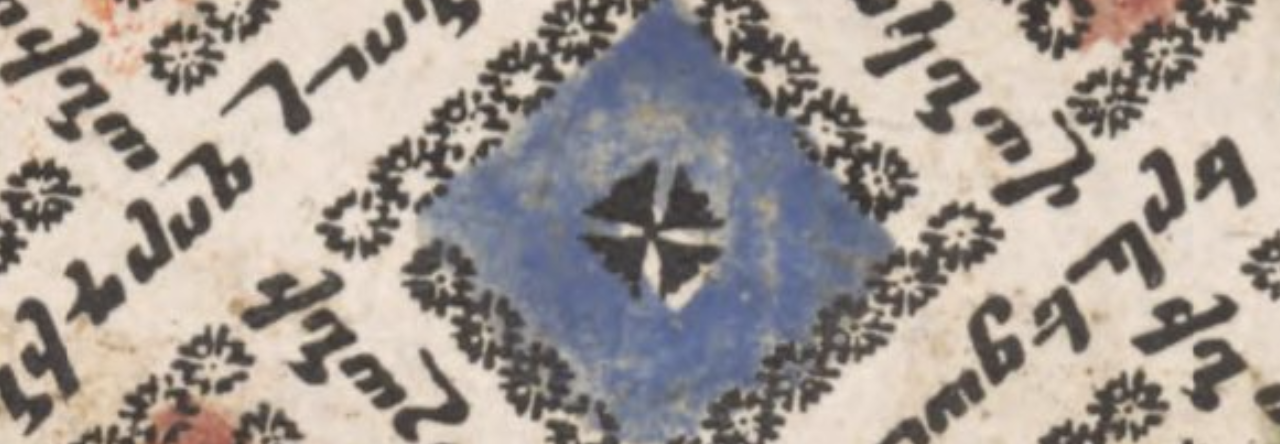
NEW BOOK ANNOUNCEMENT: Eighteenth-Century Hmayil (Prayer Scroll) by Matthew J. Sarkisian

An Early-Eighteenth-Century Hmayil (Armenian Prayer Scroll): Introduction, Facsimile, Transcription and Annotated Translation (New York, NY: Tarkmaneal Press, 2024), by Matthew J. Sarkisian, edited and with a foreword by Jesse S. Arlen is now available in print in both hardcover and paperback formats.

The volume is the first in the Krikor and Clara Zohrab Information Center’s Sources from the Armenian Christian Tradition series and was previously released online in digital format in 2022. The revised print edition features some updates and corrections and full-color photographs.

Cover of Matthew J. Sarkisian. An Early-Eighteenth-Century Hmayil (Armenian Prayer Scroll): Introduction, Facsimile, Transcription and Annotated Translation. Edited and with a Foreword by Jesse S. Arlen. Sources from the Armenian Christian Tradition, volume 1. New York, NY: Tarkmaneal Press, 2024 (revised print edition)

A hmayil is a handwritten or printed scroll containing prayers, supplications, Psalms, Gospel passages, hymns, and incantations. These scrolls, often richly illustrated, were a popular medium used for protection against maladies and other evils during the early modern period and were often carried or worn like a talisman. In this volume, Matthew J. Sarkisian and editor Jesse S. Arlen provide the Armenian text and an English translation of one such scroll printed in Constantinople in 1727. Together with facsimile images of the hmayil, this volume offers the reader an experience similar to unrolling and reading the original scroll. The translation is accompanied by an introduction, extensive annotation, and appendices, which bring to light the Scriptural and theological background as well as the folk and traditional characteristics of the hmayil’s texts and illustrations, making this fascinating artifact accessible to the general reader in the twenty-first century.

The publication of this volume was supported by a generous grant from Souren A. Israelyan. The book is available to purchase on Amazon.

Collection of anniversary, memorial, and event materials now available at the Zohrab Information Center

A collection of hundreds of documents commemorating Armenian people, places, and anniversaries has recently been processed and is now available for the interested public to view at the Zohrab Information Center

Two anniversary booklets for the Holy Cross Church of Armenia in New York, New York
Two anniversary booklets for the Holy Cross Church of Armenia in New York, New York. The second booklet is also commemorative of the miraculous icon painting Charkhapan Soorp Asdvadzadzin by Simon Samsonian. Many of the parishes within this collection have booklets commemorating multiple anniversaries.

The collection includes commemoration books, pamphlets, event programs and flyers, yearbooks, orders of service for unique church events, and memorial materials for individuals.

A commemorative booklet for the 40th anniversary of the Khorenian Divine Liturgy, 2024.
A commemorative booklet for the 40th anniversary of the Khorenian Divine Liturgy, 2024. While the Zohrab Center has a liturgy collection, liturgy that was specific to one-time events was primarily placed in this collection.

This body of materials is a comprehensive look at the many ways in which Armenian people the world over have celebrated each other, organizations and groups, and milestones, a testament to the effort, especially in the Armenian diaspora, to preserve memory in the wake of genocide and exile. 

A booklet commemorating the sesquicentennial (150th) anniversary of the Surp Pirgic Hospital of Istanbul, Türkiye, 1981.

The collection was processed by Linda Smith, an archival intern at the Zohrab Center who is beginning a graduate program through New York University’s Moving Image Archiving and Preservation in fall 2024. Additionally, Dr. Nareg Seferian assisted with processing and translation of the Armenian and other materials in the collection in non-English languages.

Booklet containing the Order of Consecration of a Church and the Divine Liturgy for St. Yeghiche Armenian Church in London, England. 2001.
A booklet for one of the newer Armenian churches in the collection, which contains the Order of Consecration of a Church and the Divine Liturgy for St. Yeghiche Armenian Church in London, England, 2001.

The materials in the collection span over 120 years, originating from 1903 and continuing through to 2024. These items were acquired and donated over the years by various individuals.

Photographic spread from the 2023 booklet for the St. Nersess Seminary event 12 Vocations.
A photographic spread from the 2023 booklet for the St. Nersess Armenian Seminary event 12 Vocations.

The collection’s first series comprises materials related to institutions and is broken down into three subseries: parishes, schools and seminaries, and organizations and other groups. 

There is a wealth of commemoration books for Armenian churches all over the world (with a bulk of materials on churches in America) and several commemorative materials for the diocese itself.

Commemorative issue of The Mother Church magazine honoring the 80th anniversary of the establishment of the Western Diocese of the Armenian Church of North America.
Commemorative issue of The Mother Church (Մայր Եկեղեցի) magazine honoring the 80th anniversary of the establishment of the Western Diocese of the Armenian Church of North America. That anniversary was in 2007, though this magazine was published at the end of 2006. This collection contains several materials commemorating anniversaries of the Western and Eastern dioceses in America and the Diocese of Canada.

These kinds of items give a glimpse into the rich history of Armenian churches and their impact within their communities. Many of the commemorative books feature letters of appreciation and well wishes from religious leaders as well as politicians, at the local, state, and federal levels.

The second subseries highlights a number of Armenian schools and seminaries around the world, and how they have fostered the education of Armenian students for decades.

A special issue of the AGBU Mari Manukean Varzharan (AGBU Marie Manoogian School) school serial Dprots’akan Keank’ (School Life) dedicated to the school’s 15th anniversary, 1991. Materials about the legacy of Marie and her husband Alex are also available in the philanthropists subseries of this collection.
A special issue of the AGBU Mari Manukean Varzharan (AGBU Marie Manoogian School) school serial Դպրոցական Կեանք (Dprots’akan Keank’, School Life) dedicated to the school’s 15th anniversary, 1991. Materials about the legacy of Marie and her husband Alex are also available in the philanthropists subseries of this collection.

This subseries is more global in scope, which allows visitors browsing the collection to get a sense of the span of the Armenian diaspora and its effort to foster spiritual and cultural education around the world.

A booklet and letter calling for admissions for the Armenian College and Philanthropic Academy of Kolkata (Calcutta), India (Կալկաթայի Հայոց Մարդասիրական Ճեմարան), circa early- to mid-2010s. The schools and seminaries subseries of the collection provides a global view of Armenian spiritual and cultural education in the wake of the diaspora.
A booklet and letter calling for admissions for the Armenian College and Philanthropic Academy of Kolkata (Calcutta), India (Կալկաթայի Հայոց Մարդասիրական Ճեմարան), circa early- to mid-2010s.
Commemorative booklet for the 150th anniversary and the occasion of the re-inauguration of Bardizatagh in Jerusalem, Israel, 1993. The booklet contains a history of the monastery, photographs of the grounds and clergy members, and a message from Archbishop Torkom Manoogian.

The third subseries focuses on various organizations and groups, mostly based in North America. 

A booklet commemorating the centennial (100th) anniversary of the establishment of an Armenian community in Ontario, Canada, 1998.

These groups have supported Armenian camaraderie and causes for decades, with some groups providing specific assistance to children, seniors, and students. Many of these groups continue a legacy of accomplishment and support into the present day for Armenian people. 

A pamphlet and booklet commemorating the centennial (100th) anniversary of the Armenian Students’ Association of America, Inc. (ASA), 2010.

Next in the collection is the individuals series. The people represented range from average citizens who worked in a variety of fields to priests and clergymen, from philanthropists to writers and artists of all sorts. 

A program booklet celebrating the 40th anniversary of the establishment of the St. Nersess Armenian Seminary in Armonk, New York by Archbishop Tiran Nersoyan, 2002.

The clergy subseries has a plethora of materials, honoring the ordinations of various holy men in the Armenian Church and remembering their lives and legacies. They all come with their own stories and personalized material. 

The ordination and consecration booklet for Benjamin Rith-Najarian as a priest, 2014. Some of these materials have notes from the presiding clergy, showing preparations taken for each ceremony.

Musicians, writers, and artists form three of the following four subseries. This collection features a varied breadth of materials from creative Armenians, who were active at various points from the end of the 19th century through the 20th century.

A program for an event honoring the artist Sarkis Katchadourian, 1956. The ZIC's second special collection contains many photographs of Sarkis and his wife Vava.
A program for an event honoring the artist Sarkis Katchadourian, 1956. The ZIC’s second special collection contains photographs of his wife Vava, many of which include Sarkis.

Their artistry continues to be appreciated and to inspire new actors, poets, authors, musicians, composers, visual artists, and singers to this day. 

An Armenian Program booklet honoring poet Avetik Isahakian, 1958; and a commemorative booklet for the 120th anniversary of the birth of Hratch Yervant, 2006.
An Armenian Program booklet honoring poet Avetik Isahakian, 1958; and a commemorative booklet for the 120th anniversary of the birth of Hratch Yervant, 2006. Though many people worked in more than one field, individuals were placed within one subseries for clarity in organization.

The fourth subseries includes materials commemorating businessmen and entrepreneurs whose philanthropic efforts have been wide-reaching. Whether they generally supported the Armenian community, philanthropic organizations, and Armenian studies at universities like Alex Manoogian or championed public institutions including the New York Public Library like Vartan Gregorian, these individuals used their success to support people and groups in need throughout their lives. 

A 2022 commemorative publication honoring the life and legacy of Vartan Gregorian one year after his passing.

The final series consists of events and milestones more broadly. These materials either cannot easily be associated with an institution or individual(s), or are of such a general nature that they are better studied in a separate category. A highlight of this series is several materials relating to the 1700th anniversary of the adoption of Christianity as the state religion of Armenia, a milestone commemorated in 2001.

One of the collection's many commemorative materials for the 1700th anniversary of the adoption of Christianity as the official religion of Armenia, 2001. This booklet also honors a pontifical visit from Karekin II, Catholicos of All Armenians to the Diocese of Canada.
One of the collection’s many commemorative materials for the 1700th anniversary of the adoption of Christianity as the official religion of Armenia, 2001. This booklet also honors a pontifical visit from Karekin II, Catholicos of All Armenians to the Diocese of Canada.

This collection brings together a plethora of resources. The collection shows how Armenians have acknowledged both tragedy and joy for over 120 years, honoring those people and places lost as well as remembering times of growth and prosperity.

Commemorative booklet containing the order of canonization of the martyrs of the Armenian Genocide. 2015.
A commemorative booklet containing the order of canonization of the martyrs of the Armenian Genocide, 2015.

All throughout the series highlights the efforts of Armenians, especially in the diaspora, to preserve memory and document their own history.

Spread from a booklet from an Armenian history contest held in honor of Archbishop Torkom Manoogian’s 20th year as primate. 1982.
A spread from a bilingual booklet from an Armenian history contest held in honor of Archbishop Torkom Manoogian’s 20th year as primate, 1982.

This collection is now available for visitors who want to research commemorative events and materials and learn more about individuals, groups, and milestones integral to the history and legacy of Armenian people around the world. A searchable finding aid of the collection is available to view here.

A poster drawn by Yervant Nahabedian commemorating the 400th anniversary of the establishment of Nor Jougha/New Julfa, Iran, 2004.

Fr. Hovsep Karapetyan awarded Dolores Zohrab Liebmann Fund Fellowship

Mrs. Dolores Zohrab Liebmann was the daughter of the early twentieth-century Armenian intellectual, writer, and statesman Krikor Zohrab. During her lifetime, Mrs. Liebmann supported educational and charitable organizations, with a primary concern to attract and support students with outstanding character and ability, who would hold promise for achievement and distinction in their chosen fields of study.

Through a generous bequest at her death, Mrs. Liebmann created a perpetual charitable trust designated as The Dolores Zohrab Liebmann Fund for the purpose of funding advanced education and graduate study grants, which must be carried out entirely in the United States of America.

The Eastern Diocese is among the select institutions eligible to nominate one candidate per year for the Dolores Zohrab Liebmann Graduate Fellowship. Fellowships are renewable for three years and cover the cost of tuition and provide a stipend for living expenses.

We are pleased to announce that Diocesan nominee Fr. Hovsep Karapetyan, a Ph.D. Candidate in the School of Theology and Religious Studies at the Catholic University of America and pastor of St. Mary Armenian Church in Washington, DC, has been awarded the Dolores Zohrab Liebmann Fund Fellowship for academic year 2024–2025.

Fr. Hovsep Karapetyan, pastor of St. Mary Armenian Church in Washington, DC and Ph.D. Candidate in the School of Theology and Religious Studies at the Catholic University of America

Born in Armenia, Fr. Hovsep undertook study at Gevorgian Theological Seminary in Etchmiadzin and the Seminary of the Armenian Patriarchate in Jerusalem, graduating from the latter institution in 1997. In 2000, he earned a Master of Divinity from St. Nersess Armenian Seminary and St. Vladimir’s Orthodox Theological Seminary, writing a thesis on the 13th-century Armenian Church father Kirakos of Erzinka’s On the Eight Thoughts of Evagrius, published in the St. Nersess Theological Review vols. 5–6 (2000–2001).

After his graduation in 2000, he was appointed as deacon-in-charge of St. James Armenian Church in Richmond, VA. He was ordained into the holy priesthood of the Armenian Apostolic Church on February 22, 2004, by His Eminence Archbishop Khajag Barsamian. While in Richmond he also was instrumental in establishing a mission parish in the Tidewater area and served as the visiting pastor for the Armenian Church of Virginia’s Tidewater region.

In April of 2007, Fr. Hovsep was appointed as the pastor of St. Mary Armenian Church in Washington, DC, where he presently serves.

At the Catholic University of America, his research explores the works of the fourth-century Saint Evagrius of Pontus and their reception and significance in the Armenian monastic tradition. Evagrius’ writings, notable for their philosophical depth and rooted in the Alexandrian philosophical tradition, have profoundly impacted both Eastern and Western monastic traditions. In contrast, however, to his controversial legacy in the Greek and Latin traditions, in the Armenian tradition, Evagrius was venerated as a saint, and his teachings were diligently translated and preserved in numerous manuscripts.

In 2022, with Prof. Robin Darling Young, Fr. Hovsep Karapetyan co-authored Evagrius Ponticus, Letters. Armenian Translation, Corpus Scriptorium Christianorum Orientalium vol. 704 (Louvain: Peeters), a critical edition of a fascinating medieval reworking of the fourth-century Letters (and additional works) of Evagrius, wherein the letters are presented not as letters by Evagrius alone but as a correspondence between Evagrius and desert mother Melania the Elder. Continually interwoven with Biblical texts, they show the monastic teacher as a gnostikos guiding his female ascetic pupil.

Evagrius Ponticus, Letters. Armenian Translation. Edition, translation, and comments by Robin Darling Young and Hovsep Karapetyan, CSCO vol. 704 (Louvain: Peeters, 2022)

Fr. Hovsep Karapetyan’s dissertation aims to offer a critical examination, along with the first translation into English, of two of Evagrius’ central works in Armenian, Praktikos (Արդիւնաւոր) and Gnostikos (Գիտնաւոր). The research will investigate how these works were received and adapted in Armenian monasticism, with particular attention to their controversial dogmatic views. It will also assess the influence of Evagrius’ teachings on Armenian monastic thought and practice. In addition to providing much needed critical editions of these texts, his dissertation will contribute new insights into their spiritual and philosophical significance and highlight their role in shaping Armenian spirituality and theological discourse throughout the ages.

Fr. Hovsep said, “Receiving the Dolores Zohrab Liebmann Fellowship is both an honor and a privilege, greatly supporting my studies and ministry. I extend my heartfelt gratitude to the Diocesan Zohrab Center for their support and invaluable assistance in the application process. This fellowship will significantly aid in advancing my research and the successful completion of my program.”

The Dolores Zohrab Liebmann Fellowships are awarded only to candidates who have outstanding undergraduate records, have demonstrated a need for financial assistance, are citizens of the United States of America, are enrolled in accredited colleges and universities in the United States, and have received baccalaureate degrees. The trustees welcome applications from students of all national origins who are United States citizens.

Applications for the next cycle of funding will be announced in the Fall.

A Bibliography of Krikor Zohrab now available on the Zohrab Center Blog

Honoring the legacy of the eponymous intellectual of the Center, a bibliography of writer, lawyer, and parlamentarian, Krikor Zohrab, who also became victim to the Armenian Genocide, has been included under the biography page of our website.

Prepared by our very own Arthur Ipek back in 2015, and recently updated, it includes works published by Zohrab in Armenian, in addition to works about his personal life and literary legacy and translations into English, French, and Turkish. Although the bibliography has been prepared in Armenian, non-Armenian works are also noted.

The bibliography is freely available to download in .pdf and .docx format.

Photograph of Krikor Zohrab, Box 3, Folder 17, Dolores Zohrab Liebmann Collection (Collection 001). ZIC Special Collections, Krikor and Clara Zohrab Information Center. Diocese of the Armenian Church of America (Eastern), New York, NY.

Recording of Odes of Saint Nersess the Graceful discussion now available

The recording of the conversation between Prof. George Demacopoulos with Dr. Jesse S. Arlen and Matthew J. Sarkisian on their book Odes of Saint Nersess the Graceful: Annotated Translation (New York, NY: Tarkmaneal Press, 2024) is now available to view on YouTube.

The Zoom webinar was hosted by the Orthodox Christian Studies Center of Fordham University and co-sponsored by NAASR and the Zohrab Information Center.

The book is available to purchase from Armenian booksellers, including the NAASR bookstore, AGBU bookstore, Abril Books, and the Prelacy Bookstore as well as via Amazon.

In-Person Book Presentation of Odes of Saint Nersess the Graceful at St. Vartan Cathedral (May 19, after Badarak)

On Sunday, May 19th at 1:00pm after Pentecost Badarak at St. Vartan Cathedral, Dr. Jesse Arlen, director of the Diocese’s Zohrab Center, and Matthew Sarkisian, a self-taught translator of Classical Armenian from the Binghamton, NY area, will present their recently released book, Odes of Saint Nersess the Graceful: Annotated Translation (New York, NY: Tarkmaneal Press, 2024), a translation and study of 60 hymns by Catholicos Nersess. Copies of the book will be available at the event for sale, and a book signing will follow.

For those unable to attend, books may be purchased via Armenian booksellers (NAASR bookstoreAbril BooksPrelacy Bookstore, AGBU Bookstore) as well as domestically and internationally through Amazon.

About the Book

St. Nersess the Graceful (Nersēs Shnorhali, 1102–1173 A.D.), catholicos from 1166 until his death in 1173, was one of the great figures of the medieval Armenian Church. His most popular work is the prayer of twenty-four stanzas commonly known as “With Faith I Confess” (Havadov Khosdovanim), which has been translated into more than thirty languages. He was also a prolific author and composer of hymns and other poetic works, many of which remain little known today. This volume presents the Armenian text and an English translation of sixty of St. Nersess’s liturgical odes (tagh), fifty-eight of which have never been previously translated into English. These profound songs of praise were composed to enhance the celebration and reflect on the mystery of the various feasts and commemorations that make up the Christian liturgical year. The translation is accompanied by an introduction and extensive annotation, which brings to light the Biblical, theological, and poetic features of these literary treasures, making them accessible to the general reader in the twenty-first century.

About the Authors

Jesse S. Arlen is the director of the Krikor and Clara Zohrab Information Center at the Diocese of the Armenian Church of America in New York and a postdoctoral research fellow at the Orthodox Christian Studies Center of Fordham University. He has published a number of studies on medieval Christian spirituality and literature.

Matthew J. Sarkisian is a self-taught translator of Classical Armenian who lives in the Binghamton, New York area. He previously collaborated with Jesse Arlen on an annotated translation of an Armenian prayer scroll (hmayil), published in 2022 by the Krikor and Clara Zohrab Information Center.

About the Press

Tarkmaneal Press was founded in 2024 by Matthew J. Sarkisian and Jesse S. Arlen with the goal of bringing bilingual editions of classical Armenian texts with annotated English translations available to a wide audience. Sarkisian is a self-taught translator of Classical Armenian who lives in the Binghamton, New York area. He previously collaborated with Jesse Arlen on an annotated translation of an Armenian prayer scroll (hmayil), published in 2022 by the Krikor and Clara Zohrab Information Center. Arlen is the director of the Krikor and Clara Zohrab Information Center at the Eastern Diocese of the Armenian Church of America, and a postdoctoral research fellow at the Orthodox Christian Studies Center of Fordham University. He has published a number of studies on late antique and medieval Christian spirituality and monastic literature.

Praise for the Volume

“St. Nersess Shnorhali, Nersess the Graceful, belongs to the rank of those Church Fathers and Doctors who rightfully can be declared “the lyre of the Holy Spirit.” One of the earliest European Armenologists, the Jesuit Fr. Jacques Villote, admiring the sublime touches of heavenly inspiration emanating from Shnorhali’s verses, called his poetic masterpiece — named in Armenian Յիսուս, Որդի (Jesus, Son) from its incipit — “The Divine Elegy.” Nersess Shnorhali is one of the most exceptional figures in the history of the universal Church for more than one reason, but above all for his passionate search for the unity of the Church, and for his deep understanding, in the wake of St. Gregory of Narek, of the fragility, the conventionality, the inadequacy of human language in speaking of Divine mystery. The Odes in this volume, masterfully translated and commented upon by Matthew J. Sarkisian and Jesse S. Arlen, are among the most vibrant, genuine, and touching expressions of Shnorhali’s spirituality.”

— Abp. Levon Zekiyan, Emeritus Professor of Armenian Studies, Ca’ Foscari, Venice, and the Pontifical Oriental Institute, Rome

“St. Nersess Shnorhali’s hymns are known for their literary beauty and spiritual sublimity. Sarkisian and Arlen convey both aspects in their mellifluous translation. The substantial annotation they provide further defines their mastery of the classical text.”

— Abraham Terian, Emeritus Professor of Armenian Patristics and Theology, St. Nersess Armenian Seminary

“Thanks to Jesse Arlen and Matthew Sarkisian for this carefully prepared labor of love and learning. They have curated for us a trove of lesser-known, spiritual gems from the vast storehouse of St. Nersess Shnorhali’s writings.”

— Roberta Ervine, Professor of Armenian Christian Studies, St. Nersess Armenian Seminary