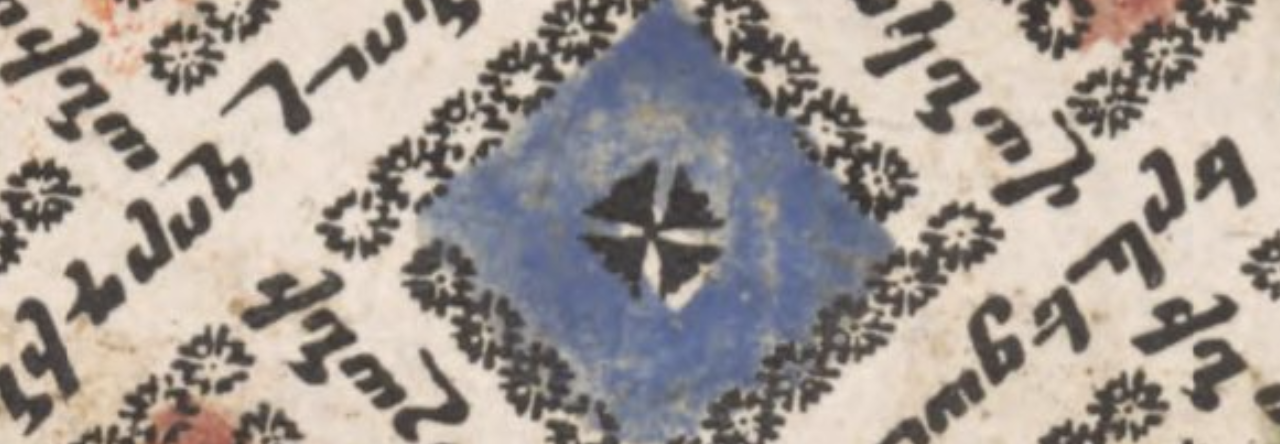
The Zohrab Information Center is hosting a Գրաբար reading course, “Medieval Armenian Poetry,” on Mondays 2:00–4:00pm ET via Zoom from January 13th to March 31st. The course will be taught by Dr. Jesse Arlen with poetic texts chosen from the rich treasury of medieval Armenian literature.
It is recommended that participants already be familiar with the basics of Classical Armenian grammar or have reading and writing knowledge of Modern Armenian in order to benefit from the course.
To register for the course, click here. For questions about the course, send an email to: zohrabcenter@armeniandiocese.org.
An Early-Eighteenth-Century Hmayil (Armenian Prayer Scroll): Introduction, Facsimile, Transcription and Annotated Translation (New York, NY: Tarkmaneal Press, 2024), by Matthew J. Sarkisian, edited and with a foreword by Jesse S. Arlen is now available in print in both hardcover and paperback formats.
The volume is the first in the Krikor and Clara Zohrab Information Center’s Sources from the Armenian Christian Tradition series and was previously released online in digital format in 2022. The revised print edition features some updates and corrections and full-color photographs.
Cover of Matthew J. Sarkisian. An Early-Eighteenth-Century Hmayil (Armenian Prayer Scroll): Introduction, Facsimile, Transcription and Annotated Translation. Edited and with a Foreword by Jesse S. Arlen. Sources from the Armenian Christian Tradition, volume 1. New York, NY: Tarkmaneal Press, 2024 (revised print edition)
A hmayil is a handwritten or printed scroll containing prayers, supplications, Psalms, Gospel passages, hymns, and incantations. These scrolls, often richly illustrated, were a popular medium used for protection against maladies and other evils during the early modern period and were often carried or worn like a talisman. In this volume, Matthew J. Sarkisian and editor Jesse S. Arlen provide the Armenian text and an English translation of one such scroll printed in Constantinople in 1727. Together with facsimile images of the hmayil, this volume offers the reader an experience similar to unrolling and reading the original scroll. The translation is accompanied by an introduction, extensive annotation, and appendices, which bring to light the Scriptural and theological background as well as the folk and traditional characteristics of the hmayil’s texts and illustrations, making this fascinating artifact accessible to the general reader in the twenty-first century.
The publication of this volume was supported by a generous grant from Souren A. Israelyan. The book is available to purchase on Amazon.
The Zohrab Center warmly invites you to our next in-person event, a public lecture by Tamar Purut, entitled, “Frik’s Relatable Freakshow: Echoes of Faith and Endurance for Confronting Today’s Geopolitical Turmoil.” This interactive lecture will take place in Yerevan Room of the Diocesan Center on Thursday, December 12th at 7:00pm. All are welcome to attend.
Tamar Purut is a first-generation Armenian-American born and raised in New Jersey. She holds a Bachelor’s Degree in Philosophy and Political Science from Seton Hall University, a Master’s Degree in International Security from University College London, and, most recently, a postgraduate degree in Classical Armenian Studies from the University of Oxford. She is seasoned in operating anti-money laundering and compliance programs at first-tier global financial institutions and is presently an Assistant Vice President at BHI Bank. Tamar wishes to continue serving her compatriots while inspiring further discourse on what it means to be an Armenian in the diaspora while remembering and honoring her roots.
Description of Lecture: This talk will explore the life and legacy of Frik, one of Armenia’s most influential medieval poets. Through his eloquent verse, Frik captured the struggles of his time, blending profound theological reflection with poignant political commentary. His work delves into the complex relationship between faith, identity, and the ever-shifting contours of power. The presentation will examine how Frik’s writings, though rooted in the medieval Armenian experience, continue to resonate with contemporary geopolitical conflicts and questions of faith. Tamar will discuss how his reflections on the human condition and the search for divine justice offer timeless insights into the challenges we face today. This will be an opportunity to (re)discover how Frik’s poetic vision still echoes in modern debates about religion, conflict, and the pursuit of meaning in an increasingly fragmented world.
The personal papers of Dolores Zohrab Liebmann, foundress and benefactress of the Zohrab Information Center, have been processed, and the collection is now available for the interested public to view and research at the Zohrab Center. It was the first such archival special collection processed by the Center (in the late winter of 2022 and spring of 2023), serving as a model for the subsequent special collections of unique, mostly unpublished materials now available for viewing and research. Under the guidance and with the collaboration of Center director Dr. Jesse S. Arlen, the papers were processed by Dn. Andrew Kayaian, former long-time employee of the Center who is now the librarian of St. Vladimir’s Seminary and is currently a graduate student at Simmons University pursuing a Library and Information Science degree.
Mrs. Dolores Liebmann née Zohrab was born in Istanbul on January 13, 1896 (recorded in the certificate as January 2, 1896, according to the Julian/Old Style Calendar).
Sealed document from the Armenian Patriarchate of Istanbul (“Stanboul” in Armenian), primarily written in French, giving Dolores’ birth information and details surrounding her baptism of July 23, 1896 (August 3, 1896 according to the Gregorian Calendar/New Style).
She was one of four children, along with her sister Hermine and brothers Aram and Leo, of Krikor Zohrab, the famous Ottoman-Armenian community leader, parliamentarian, lawyer, and writer, and his wife Clara Zohrab née Yazidjian.
Photograph of Krikor ZohrabDolores’ mother Clara (standing, center), Dolores herself (standing on the right, on Clara’s left side), and Dolores’ sister and brothers.
With the initiation of the Young Turks’ genocidal policies in 1915, Dolores was a witness to Krikor’s arrest and removal by the Ottoman government. Her brothers were attending school in France at the time. Clara Zohrab escaped with Dolores and her sister Hermine from Istanbul to Paris, France through Austria to join the boys in order to avoid a similar fate in Turkey. Dolores and Hermine remained in Paris until the death of their mother some years later, after which Dolores moved to Romania where one of the brothers was living at the time.
In Romania, Dolores Zohrab met and eventually married Henry L. (Leopold) Liebmann (1871-1950) in 1932; Dolores was Henry’s second wife. Henry Liebmann was a member and heir of the Liebmann family in New York, which had made its fortune from their brewery business in Brooklyn. The brewery was well known in the New York metropolitan area and the larger East Coast of the United States as the producer of the popular Rheingold Beer.
Front page of the Liebmann’s marriage license.
Open interior of the marriage certificate. Notice that the certificate asks for their religious backgrounds: it lists Henry’s Jewish roots as “Mozaica” and Dolores’ Armenian Church roots as “Gregoriana,” (‘Gregorian’), a not uncommon designation for the Armenian Church.
After their marriage, Dolores and Henry returned to America, residing in New York City, which she would call home for the rest of her life. The married couple would often vacation around Lake Tahoe in California and take cruises.
Henry Liebmann died in 1950, leaving his estate to Dolores. For the next forty years, she was a perennial name in and among high society in New York and the wider American Armenian community. Besides the various official papers, the collection of her papers also contains many letters and other correspondence. From these one sees that Dolores was well connected and in contact with many prominent Armenians in America of the twentieth century.
Dolores in the company of Eastern Diocese Primate Archbishop Torkom Mannoogian, benefactors Haig and Alice Kavookjian, and singer Charles Aznavour.
Dolores in the company of the late academic/educator/historian/administrator Vartan Gregorian and scholar S. Peter Cowe, among others.
For example, the collection contains Dolores’ correspondence with the Eastern Diocese regarding the publication of a book of selections of her father Krikor Zohrab’s writings (Voice of Conscience), some correspondence with entrepreneur and philanthropist Alex Manoogian, and materials concerning Dolores’ patronage of Armenian studies at Columbia University.
She appears to have been a close friend of famed Armenian Studies scholar and art historian Sirarpie Der Nersessian and her sister Arax Der Nersessian.
An air mail letter between Dolores (“Ma Cherie Dolly”) and Sirarpie, one of many pieces of air mail.
Taking inspiration from her upbringing, she was a major patroness of Armenian culture and education, especially in America but also throughout the world. The Mesrob School in France sent her a letter of gratitude for her patronage; the Armenian Museum of Literature sent a thank you letter (image below) for her donation of Krikor Zohrab’s papers.
Thank you letter from the Armenian Museum of Literature for the donation of Krikor Zohrab’s papers
Toward the end of her life, Dolores founded the Krikor and Clara Zohrab Information Center to function as a major hub of information collection and distribution among the Armenian American community. There are some materials from the opening of the Center on November 17, 1987, as well as photographs showing Dolores in the company of Catholicos Vasken I and then-Primate Archbishop Torkom Manoogian.
A cropped photo of the photo collage in the Zohrab Center reading room: the center image in the top row shows the 1987 opening ceremony with Dolores, Catholicos Vasken, and Archbishop Torkom. Atop the frame is Dolores’ cane.
Front page of an informational pamphlet about the Zohrab Center.
Thank you letter to Dolores from her law firm in gratitude for the “brochure” she sent to them connected to the Center’s opening.
Cover of the program published for the opening of the Center in 1987.
Dolores was eventually awarded the St. Nerses Shnorhali Medal in recognition of her philanthropy and dedication to the Armenian community by Catholicos Vasken, the encyclical for which hangs in the reading room of the Center.
The encyclical for Dolores’ reception of the St. Nerses Shnorhali Medal in the Zohrab Center reading room.
The St. Nerses Shnorhali medal
Dolores Zohrab Liebmann passed away in 1991; in her will, she established an endowment to sustain the Zohrab Information Center. Among other philanthropic endeavors, she also established The Dolores Zohrab Liebmann Fund, which supports the publication of books in Armenian studies and provides funding for graduate studies. This collection chronicles the extraordinary life of a great lady in the twentieth century Armenian community and is a major resource for all those interested in twentieth-century Armenian life, especially in America but also throughout the world.
Luiza Ghazaryan with her poster, “Reviving Lost Memories: Kazanjian’s Kharpert” at the MLK Scholars Research Symposium
On Wednesday, October 23rd, Zohrab Center intern Luiza Ghazaryan (NYU ’26) presented original research at the NYU Martin Luther King, Jr. Scholars Program Research Symposium.
Conducted under the supervision of Zohrab Center director, Dr. Jesse S. Arlen, the basis of Luiza’s research was an over 800 page handwritten manuscript by Pilibos Kazanjian, entitled Խարբերդ եւ իր գիւղերը (Kharpert and its Villages), written in a form of Western Armenian with large impact from the Kharpert dialect and full of borrowings from Turkish, Kurdish, Arabic, and Greek. Working with Dr. Arlen, Luiza translated selected portions from this lengthy, unpublished manuscript.
Zohrab director Dr. Jesse Arlen, Luiza Ghazaryan, and Zohrab Special Projects Coordinator Arthur Ipek
Kazanjian was born to an Armenian family in Kasirig Village in the Kharpert province of the Ottoman Empire. However, after the massacres of 1894-1897 under Sultan Abdul Hamid II, in which hundreds of thousands of Armenians were killed, he migrated to America with his wife and five children, eventually settling on a farm in the Central Valley of California (Fresno area).
After publishing several short articles in the local Fresno Armenian paper “Mushag” (Մշակ) (see issues 3, 7, and 14 in July 1931), he was asked by his compatriots to write a book on the topic, encapsulating stories and memories from the region of Kharpert. The result was over 800 handwritten pages on Kharpert and many villages in the region, detailing local customs, traditions, and memories, generally falling into the Houshamadyan (“Memory book”) genre.
Luiza’s research focused especially on Kazanjian’s information on the marriage customs of Kharpert as well as the traditional medicine, practiced mostly by the elder women of the region.
At the research symposium, Luiza also participated on a panel surrounding the topic of storytelling and research methodology.
Luiza speaking on storytelling and research methodology at a panel during the research symposium
Luiza Ghazaryan is a Biology major at NYU (class of 2026), who is also pursuing minors in Creative Writing and Chemistry. She began working at the Zohrab Center in summer 2023, as a Lily E. Jelalian summer intern, a program generously funded by Dean Shahinian and has continued at the Zohrab Center since that time.
We congratulate Luiza on her research and achievements!
Zohrab Center director, Dr. Jesse S. Arlen, will be on the road to present talks in the coming days. On Monday, October 28th at Catholic University of America in Washington, D.C., he will present on the rich manuscript heritage of Grner monastery in Cilicia under Bishop John (Yovhannes Arkayeghbayr), brother of King Hetum I.
Then on November 7th at the Western Diocese of the Armenian Church of America he will participate in a program put together by the Western Diocese and the UCLA Narekatsi Chair of Armenian Studies, Prof. Peter Cowe, entitled “An Evening Honoring the Legacy of St. Nerses Shnorhali,” a literary, musical, artistic, and visual celebration of the saint’s liturgical music, including the Odes (տաղք), newly translated to English by Dr. Arlen and Matthew J. Sarkisian.
Both programs are open to the public.
While in Washington, D.C., Dr. Arlen presented today on medieval Armenian colophons at the Armenian Relief Society Norian “Youth Connect” Program at the Library of Congress and Johns Hopkins School of Advanced International Studies, organized by Dr. Khatchig Mouradian.
The Zohrab Center warmly invites you to attend an evening with Jamanak‘s chief editor, Mr. Ara Kochunyan, on Tuesday, October 8, 2024 at 7:30pm in Guild Hall of the Diocesan Center.
A collection of hundreds of pages of notes and original research, photocopies from scholarly works, and personal papers from Loretta Topalian Nassar has recently been processed and is now available for the interested public to view at the Zohrab Information Center.
A picture of Loretta (center) and two other women, circa 2000s.
The collection was processed by Linda Smith, an archival intern at the Zohrab Center who is a graduate student in New York University’s Moving Image Archiving and Preservation program.
Volume 1, issue 2 of The Indian Athenaeum journal, published in 1923.
Loretta Topalian Nassar was born in Romania in 1936, the youngest of three girls. Her parents both came from Armenian families of textile merchants and her father opened his first textile factory in the city of Galatz. The family escaped the upheaval occurring in Romania during the 1940s and moved to Alexandria, Egypt in 1947.
Materials from Loretta’s Missions and Missionaries and Travel Literature folder (Box 2, Folder 9, materials from circa late 1990s). Even before she began studies at Columbia, Loretta was a voracious reader and researcher, often keeping clips and compiling notes and bibliographies to further her knowledge.
Nassar attended the University of Leicester, where she graduated with a Bachelor of Arts degree in English in 1959. She met Alfred Nassar in Lebanon, and they married and had three children before emigrating to the United States. At Columbia University, she worked for many years as the Director of the Society of Fellows. While there, she was encouraged by Prof. Nina Garsoïan to pursue a doctorate in Armenian history, which she worked on over the course of several decades. She focused on Armenian and world history in the early modern period and began a dissertation on Joseph Emin, which was never completed. Much of the material in this collection relates to her graduate study and research.
The front cover of a bound photocopy of the second edition of Emin’s memoir and the title page of the first edition, respectively.
Joseph Emin was an Armenian born in 1726 in Hamadan, Iran. He was raised in Calcutta, India, and went to London as a young man, where he received an education and fought in the Seven Years’ War. Later in life, he attempted to work towards Armenia’s liberation from Persian and Ottoman rule by visiting the leaders of several nations (Russia, Georgia, Karabakh, and Armenia itself) and trying to garner favor and support for this purpose. During his lengthy travels, he tried to spread the message of the European Enlightenment among his compatriots. He encountered resistance from the Armenian clerical elite of the time, who believed that Enlightenment thinking threatened the authority of the church and jeopardized Armenians living under Ottoman rule.
Materials from box 14 of the collection, which include a “rolodex” of bibliographic entries, one (of two) reels of microfilm, and a photographic plate containing Joseph Emin’s image. Photographs courtesy of Linda Smith.
He published his memoir in London in 1792, entitled The Life and Adventures of Joseph Emin the Armenian Written in English by Himself. He is considered the first Asian person to travel from India to Britain and write an account of those experiences in a European language. His great-great-granddaughter Amy Apcar published a second edition of the memoir in 1918, revising the original account and adding letters and documents by Emin and those he corresponded with. Today, he is celebrated in Armenia as a national hero and one of the pioneers of the Armenian national liberation movement. Loretta’s aim in her dissertation was to challenge the standard reception of Emin and also to explain the differences between the two editions of his autobiography.
A prompt from the Cresskill Writers’ Group and Loretta’s response, “My Uncle the Colonel,” 2009.
Over the years, Nassar took classes at The Writing Center in Englewood Cliffs, New Jersey, as she worked on her writing skill both in preparation for writing her thesis and as a creative and personal endeavor in its own right. Loretta was also part of the Cresskill Writers Group that met at the public library in Cresskill, New Jersey. She published a collection of short stories and poems entitled Hors D’oeuvres in 2004.
Loretta’s book “Hors D’Oeuvres” and a card sent by her friend Sylvie Merian (Reader Services Librarian, Morgan Library & Museum) in response, 2004-2005.
Another series in the collection focuses on her correspondence with different individuals throughout her life. The bulk of the correspondence is with Sebouh Aslanian, whom she knew from Aslanian’s time at Columbia. Prof. Aslanian is currently the Richard Hovannisian Endowed Chair in Modern Armenian History at UCLA. His research on early modern Armenian merchants from Persia and India intersects with some of Nassar’s own areas of interest and research. While much of her correspondence with Aslanian and others is about research interests, there is also a personal component to much of the material.
The University of Leicester B.A. special examination for English majors from June 1959 and a newspaper article about Queen Elizabeth II and Prince Phillip visiting the University and the prince receiving the “Order of the Boot” from students, 1958-1959.
This collection provides visitors with a comprehensive picture of the inner workings of Nassar’s scholarly research and writing practice from the 1990s through the early 2010s, in a time where computers were becoming increasingly prevalent but handwritten note-taking, manual bibliography and analysis was still the norm. There is a wealth of material on Joseph Emin and related topics, including Armenian merchants and travel writing from Europeans visiting the Near East throughout the 1700s especially. There is also much material pertaining to writing and several creative fiction and creative nonfiction pieces written by Nassar, which show her growth as a writer and attest to her personal journey as she struggled to make progress on her dissertation writing and sought other outlets of literary expression.
Pages from the program for the 26th Annual Conference on South Asia, which took place October 16-19, 1997 in Madison, Wisconsin.
This collection of Nassar’s personal papers is available for researchers to view in the Zohrab Information Center’s library. A finding aid of the collection is available to view here.
On Friday, October 18th at 7:00pm ET in the Yerevan Room of the Diocesan Center, the Zohrab Center is hosting an Open Mic Night in collaboration with Noor (https://www.noormag.org/), a new literary magazine & publishing platform founded in 2024 by Vladimir Mkrtchian and Madeline Berberian-Hutchinson.
Come prepared to share your original poetry, spoken word, music, singing, etc. in English or Armenian. Sign up at the event to reserve your slot. A $10 suggested donation will help support Noor magazine.
The final installment of our reading series, Literary Lights 2024, features Lory Bedikian, author of the Raz/Shumaker Prairie Schooner Book Prize in Poetry winner, Jagadakeer: Apology to the Body. Bedikian will be joined by award-winning poet, essayist and professor, Brian Turner. The event, co-sponsored between the Krikor and Clara Zohrab Information Center, the International Armenian Literary Association (IALA), the National Association for Armenian Studies and Research (NAASR), and the University of Nebraska Press and Prairie Schooner, will take place virtually on September 21, 2024 at 10:00 AM Pacific | 1:00 PM Eastern | 9:00 PM Armenia time. Register here.
Jagadakeer: Apology to the Body presents the voice of a daughter of immigrant parents, now gone, from Lebanon and Syria and of Armenian descent. In this five-part testimony Lory Bedikian reconstructs the father figure, mother figure, and the self. Using a sestina, syllabics, prose poems, and longer poetic sequences, Bedikian creates elegies for parents lost and self-elegiac lyrics and narratives for living with illness. Often interrupted with monologues and rants, the poems grapple with the disorder of loss and the body’s failures. Ultimately, Bedikian contemplates the concept of fate, destiny (jagadakeer), and the excavation of memory—whether to question familial inheritance or claim medical diagnoses.
“A capacious lyric narrative, of emigration, of history, of interiority, polyglot, with a memory reaching as far as Aleppo and as near as today’s biopsy results.” — Marilyn Hacker, author ofCalligraphies: Poems
“Lory Bedikian has created a monument of rage in facing the march of calamities against a life… Jagadakeer’s world will be very disconcerting—yet rewarding—to readers of this exquisitely composed work.” —Ed Roberson, winner of the PEN/Voelcker Award for Poetry and author of To See the Earth Before the End of the World
“A consummate craftsperson, Bedikian writes lushly, with power and force, creating images we cannot unsee. Open this book and read her poem ‘Before the Elegy, Speak to Her,’ and see what I mean.” — Dorianne Laux, author ofOnly As the Day Is Long
Lory Bedikian is is the author of The Book of Lamenting, winner of the Philip Levine Prize for Poetry. She was recently chosen for the Poets & Writers “Get the Word Out” Poetry Cohort 2024. Several of Bedikian’s poems received the First Prize Award in the Pablo Neruda Prize for Poetry as part of the 2022 Nimrod Literary Awards. Her work is published in Tin House, Gulf Coast, The Los Angeles Review, BOULEVARD, The Adroit Journal, Orion,wildness, and was featured on Pádraig Ó Tuama’s Poetry Unbound podcast. Her poem “The Mechanic,” is included in the anthology Border Lines: Poems of Migration, KNOPF, 2020. Bedikian’s manuscript-in-progress received a 2021 grant from the Money for Women/Barbara Deming Memorial Fund. Her work also appears in Massachusetts Review’s “Revisiting WOMAN: An Issue, 50 Years Later.” Bedikian earned an MFA from the University of Oregon. She teaches poetry workshops in Los Angeles and elsewhere.
Brian Turner is the author of a memoir, My Life as a Foreign Country, and five collections of poetry— from Here, Bulletto The Wild Delight of Wild Things. He’s the editor of The Kiss and co-editor of The Strangest of Theatres. A musician, he’s written and recorded albums with The Interplanetary Acoustic Team, including 11 11 (Me Smiling) and American Undertow with The Retro Legion. His poems and essays have been published in The New York Times, The Guardian, National Geographic, and Harper’s, among other fine journals, and he was featured in the documentary Operation Homecoming: Writing the Wartime Experience, nominated for an Academy Award. A Guggenheim Fellow, he’s received a USA Hillcrest Fellowship in Literature, the Amy Lowell Traveling Fellowship, the Poets’ Prize, and a Fellowship from the Lannan Foundation. He lives in Orlando with his dog, Dene, the world’s sweetest golden retriever. Learn more by visiting http://www.brianturner.org
Literary Lights is a monthly reading series organized, for the second year in a row, by IALA, the National Association for Armenian Studies and Research (NAASR), and the Krikor and Clara Zohrab Information Center. Each event—held online—features a writer reading from their work, followed by a discussion with an interviewer and audience members. Read along with the series by purchasing titles from the IALA Bookstore or the NAASR Bookstore.