Under the initiative of Fr. Hovhan Khoja-Eynatyan of St. James of Nisibis Armenian Church in Evanston, IL and dedicated to the 80th anniversary of the parish and 850th anniversary of St. Nersess Shnorhali, a video was produced entitled “Together at His Table: Different Voices, One Heart,” in which the famous prayer of 24 stanzas by St. Nersess Shnorhali was recited by 24 different individuals, each reciting or reading successive stanzas in a different language.
The Zohrab Center warmly invites you to an upcoming international conference, Շնորհալի եւ պարագայ իւր “Nerses Shnorhali in His Context,” to be held at St. Nersess Armenian Seminary from May 8–10, 2025.
You may register for the Zoom Webinar via this link.
The conference flyer and program are below. For more information, visit the St. Nersess seminary website.
Armenian artist M. Hovanessian painted his subjects, Saints Vartan and Shushanik, with great skill, and in heroic scale: each canvass measures over eight feet in height.
But they were also painted in accordance with age-old Christian traditions governing how to portray saintly subjects, to make them suitable for veneration.
Below, Zohrab Center Director Dr. Jesse Arlen offers reflections on the two icons.
Unlike realist paintings or photographs, holy icons do not attempt to depict events as they happened in a single moment of historical time. Rather, icons invite those who behold them to contemplate the meaning of events from a heavenly, divine perspective.
One encounters little historical detail in the two new icons of St. Vartan and St. Shushanik that adorn the entrance of St. Vartan Cathedral in New York City. Absent from the icon of St. Vartan are scenes of battle and bloodshed, like we find in various medieval manuscript illuminations, or modern paintings depicting St. Vartan and the Battle of Avarayr.
Absent from the icon of St. Shushanik are the gruesome tortures inflicted on the holy woman’s saintly body, which fill the pages of the Armenian and Georgian martyrologies of the saint.
What are we beholding, then, when we gaze at the icons of these two saints? Icons are famously described as “windows into heaven” or “sacred windows.” But what does that mean?
Heaven signifies the meaning of things: it is the invisible realm of reality, and we gain access to that realm through symbols. The icon is a kind of tutor, telling us of the reality behind and beyond what our physical eye can see. Icons reveal the truth—but not historical truth. It is truth of another dimension: invisible, spiritual reality, not perceivable to our physical eyes. Hence, the need for the icon, which gives us a view into heavenly reality.
In earthly, historical time, Vartan Mamikonian died in battle with other Armenian nobles. In the icon, he stands victorious, holding not a spear but a processional cross, standing at the front of what one may imagine to be a long line of heroic saints behind him.
The icon of St. Vartan by artist M. Hovanessian
Sheathed is his sword; removed his helmet. For we see Vartan not as he stood on earth, but as he stands in Heaven—where, the prophet says, “Swords are beaten into plowshares, spears into pruning-hooks; nation shall not take up sword against nation, and no more shall they learn to wage war” (Isaiah 2:4).
The saint stands atop a high place, with more of the heavens visible behind him than the earth below his feet. His cloak and the plume of his helmet are red: the color associated, in memory and symbol, with the blood he shed as a witness to His Lord, in defense of the Christian faith.
Denying himself, Vartan took up the cross he holds high with his right hand, and followed after Christ. In so doing, for the sake of Christ, he lost his life and lost the world—but gained his soul and was rewarded with eternal life (Matthew 16:24–25).
In a similar place stands St. Shushanik, daughter of St. Vartan and descendant of St. Gregory the Illuminator. Around her are white lilies, the flower after which she is named: “I am a lily (shushan) of the valleys” (Song of Songs 2:1). Like the Illuminator before her, in historical time she endured years of physical torture, beatings, and imprisonment—not at the hands of enemies but by the hand and command of her own husband, Vazgen, the apostate margrave of Georgia.
The icon of St. Shushanik by artist M. Hovanessian
Yet in the icon, we behold not a disfigured, broken body, but the immaculate body of a saintly woman. We see Shushanik as she is in heaven, where God has healed her broken heart and bound up all her wounds (Psalm 146/147:3). Lying at her feet are the unbound iron shackles with which she was once fettered in an earthly prison. But God saved her from darkness and the shadow of death, and broke away her chains (Psalm 106/107:14).
In her hand, she holds a sacred book. As we read in the historian Ukhtanes, during her tortures, “she had with her a small book, with which she performed her devotions and psalmody.” Now she stands in heaven, holding in one hand the cross and in her other the sacred Gospel, for which she endured torture, after the pattern of her ancestor St. Gregory and her Lord Jesus Christ.
She stands regally in noble raiment, crowned with the imperishable crown (1 Cor. 9:25). Behind her silent visage, it is as if we can hear her speaking the words of the prophet silently to herself, that she “has been clothed in a garment of salvation and a cloak of joy. Like a bridegroom he put a crown on my head and like a bride he adorned me with jewels” (Isaiah 61:10).
The Zohrab Center is pleased to share that the third annual Grace and Paul Shahinian Armenian Christian Art and Culture Lecture, established through the generosity of Mr. Dean Shahinian, will take place on March 27th in Washington, D.C. Please find the details below:
Lecture Title: “When Things Fall Apart: Disentangling Christian-Muslim Relations in Medieval Armenia”
Speaker: Prof. Sergio La Porta
Place: Heritage Hall in O’Connell Hall at the Catholic University of America in Washington, D.C.
Date and Time: March 27 at 5 pm
Lecture open and free to the public. Reception to follow
Dr. Sergio La Porta is currently the Acting Dean of the Kremen School of Education and Human Development at California State University, Fresno. Prior to assuming this role, he was the Associate Dean of the College of Arts and Humanities and the Haig and Isabel Berberian Professor of Armenian Studies. His most recent book publication, co-authored with Dr. Alison Vacca, is entitled, An Armenian Futūḥ Narrative: Łewond’s Eighth-Century History of the Caliphate (Chicago: Institute for the Study of Ancient Cultures, 2024). In addition, Dr. La Porta has published on the Armenian commentaries on the works attributed to Dionysius the Areopagite, and numerous articles on medieval Armenian intellectual history and cultural interactions with the Islamicate, Byzantine, and Latinate worlds.
The Byzantine annexation of Armenia in the eleventh century followed by the Seljuk invasions brought dramatic political and demographic changes to the region. Nonetheless, a modus vivendi between Christians and Muslims in Armenia was established by the end of that century. This condition of “rough tolerance,” to borrow a phrase used by MacEvitt in the context of the Crusades, lasted until the second half of the twelfth century. This talk will argue that contemporary Armenian stories of martyrdom both shed light on the previous state of affairs and document the disintegration of intercommunal relations during this period.
Past Lectures in the Grace and Paul Shahinian Armenian Christian Art and Culture Lecture Series:
(1) The inaugural lecture was on March 23, 2023 at 5 pm (Heritage Hall, The Catholic University of America). The speaker was Prof. Christina Maranci (Harvard University) who spoke on the topic “Armenia and the World in Art and Text.” For a video of the lecture, see https://www.youtube.com/watch?v=SBccQFf1Tmg&t=15s
(2) On March 21, 2024 we hosted the Second Annual “The Grace and Paul Shahinian Armenian Christian Art and Culture Lecture Series.” The speaker was Prof. Zara Pogossian (University of Florence) who spoke on the topic “Women and Power in Medieval Armenia: Beyond Local Dynasties and Eurasian Empires.” For a video of the lecture, see https://www.youtube.com/watch?v=R-Uyg8VUfzc&t=212s
We warmly invite you to our next in-person event on Tuesday, March 4th at 7:00pm in Guild Hall of the Diocesan Center in New York. Lecturing on Armenian Martyrs in Text and Image will be St. Nersess Armenian Seminary professor Dr. Ani Shahinian.
Dr. Ani Shahinian is the Assistant Professor in Armenian Christian Art and Culture, holder of the Grace and Paul Shahinian Lectureship, at the St. Nersess Armenian Seminary and St. Vladimir’s Orthodox Theological Seminary. She earned her doctorate in History and Theology at the University of Oxford. She holds an MA degree in Near Eastern and Languages and Cultures from University of California, Los Angeles (UCLA), and a diploma in Philosophy and Theology from the University of Oxford. She received her BA in Philosophy, Ethics, Public Policy, and Professional Writing from the University of California, Santa Barbara (UCSB). Shahinian’s doctoral research addresses the question of Christian martyrdom in the context of political, economic, and ecclesiastical history in Late Medieval Armenia. More broadly, Shahinian’s research interests address questions of what it means to be human in a technological age, focusing on virtue-ethics and the freedom of the human will.
On Thursday, January 16th at 7:00pm PT / 10:00pm ET, Dr. Jesse Arlen will give a presentation hosted by the Hamazkayin Western Region Literary Unit on St. Nersess Shnorhali and the recently published book by co-authors Jesse Arlen and Matthew Sarkisian Odes of St. Nersess the Graceful: Annotated Translation (New York: Tarkmaneal Press, 2024).
Please register for this online event, whose proceedings will take place primarily in Armenian, at this link.
An Early-Eighteenth-Century Hmayil (Armenian Prayer Scroll): Introduction, Facsimile, Transcription and Annotated Translation (New York, NY: Tarkmaneal Press, 2024), by Matthew J. Sarkisian, edited and with a foreword by Jesse S. Arlen is now available in print in both hardcover and paperback formats.
The volume is the first in the Krikor and Clara Zohrab Information Center’s Sources from the Armenian Christian Tradition series and was previously released online in digital format in 2022. The revised print edition features some updates and corrections and full-color photographs.
Cover of Matthew J. Sarkisian. An Early-Eighteenth-Century Hmayil (Armenian Prayer Scroll): Introduction, Facsimile, Transcription and Annotated Translation. Edited and with a Foreword by Jesse S. Arlen. Sources from the Armenian Christian Tradition, volume 1. New York, NY: Tarkmaneal Press, 2024 (revised print edition)
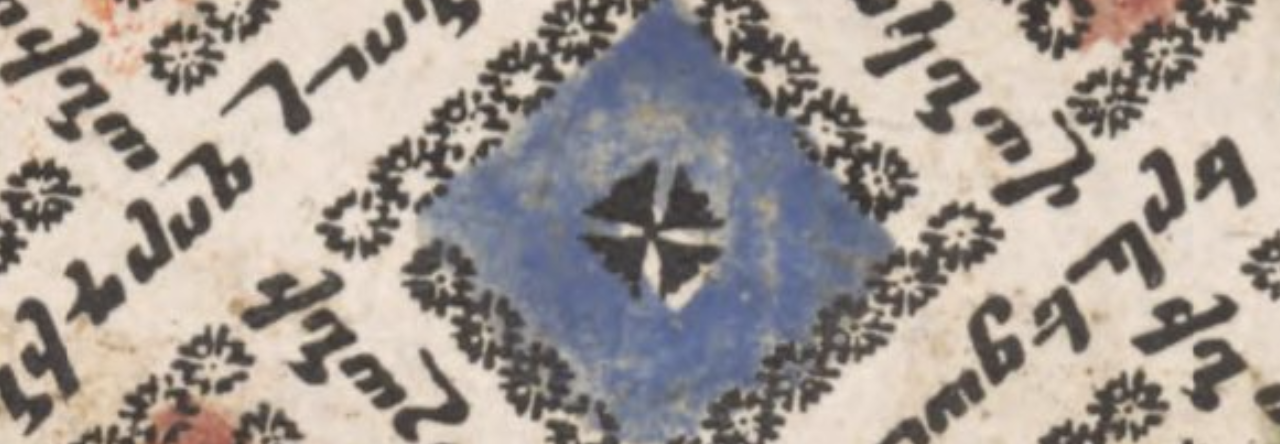
A hmayil is a handwritten or printed scroll containing prayers, supplications, Psalms, Gospel passages, hymns, and incantations. These scrolls, often richly illustrated, were a popular medium used for protection against maladies and other evils during the early modern period and were often carried or worn like a talisman. In this volume, Matthew J. Sarkisian and editor Jesse S. Arlen provide the Armenian text and an English translation of one such scroll printed in Constantinople in 1727. Together with facsimile images of the hmayil, this volume offers the reader an experience similar to unrolling and reading the original scroll. The translation is accompanied by an introduction, extensive annotation, and appendices, which bring to light the Scriptural and theological background as well as the folk and traditional characteristics of the hmayil’s texts and illustrations, making this fascinating artifact accessible to the general reader in the twenty-first century.
The publication of this volume was supported by a generous grant from Souren A. Israelyan. The book is available to purchase on Amazon.
On Monday, April 15th at 4:00pm ET, authors Jesse S. Arlen and Matthew J. Sarkisian will discuss their new book, Odes of Saint Nersess the Graceful: Annotated Translation, in conversation with Prof. George Demacopoulos. The Zoom webinar is hosted by the Orthodox Christian Studies Center of Fordham University and co-sponsored by NAASR and the Zohrab Information Center.
The international conference “Plenitude of Grace, Plenitude of Humanity: St Nerses Shnorhali at the Juncture of Millennia” took place Thursday and Friday (Nov 30–Dec 1) at the Pontifical Oriental Institute in Rome. The recordings of all sessions from both days are available to view online through the YouTube Channel of the Pontifical Oriental Institute or below.A conference flyer and schedule are also available to view below.
The international conference “Plenitude of Grace, Plenitude of Humanity: St Nerses Shnorhali at the Juncture of Millennia” is taking place this Thursday and Friday (Nov 30–Dec 1) at the Pontifical Oriental Institute in Rome. Among the invited speakers are Zohrab Center director Dr. Jesse S. Arlen, former Diocesan primate Bp. Daniel Findikyan, St. Nersess Armenian Seminary Emeritus Professor Dr. Abraham Terian and current St. Nersess Seminary Professor Dr. Roberta R. Ervine, along with an impressive lineup of scholars and clergymen.
The conference was organized in conjunction with a series of events that were to take place in Rome and the Vatican, including concerts and an ecumenical prayer service, to honor the 850th year since the death of St. Nerses Shnorhali. Unfortunately, all events apart from the conference have been indefinitely postponed.
A conference flyer and schedule are available to view below: