 Anthropologist and Armenian Deacon Dr. Christopher Sheklian will deliver a lecture at the Zohrab Center on Tuesday, November 7 at 7PM entitled, Sharagans in the City: Being Armenian in Istanbul Today.
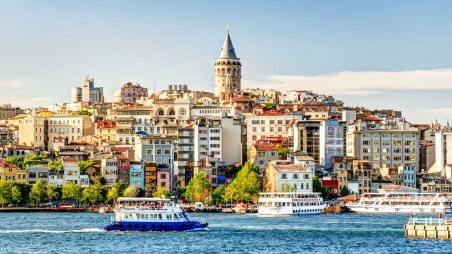
Armenians in Istanbul today navigate a city that is undeniably their home, yet often feels exclusionary. People rarely speak Armenian on the street and many of the churches are hidden behind high walls. Yet the Armenians living there do not necessarily feel excluded or discriminated  against. “Bolis” is their home, and they feel a sense of belonging there.
Dr. Sheklian will discuss the complicated sense of belonging that Armenians feel toward Istanbul and toward Turkey. He suggests that the inheritance of the Armenian Apostolic Church’s liturgy helps many Armenians to navigate the city. Through constant exposure to Armenian sharagans and other hymns, Armenians are able to hear the soundscape of Istanbul as one where they also belong.
Christopher Sheklian, a native of central California, earned his PhD in Anthropology from the University of Chicago in 2017. His dissertation, entitled, Theology and the Community: The Armenian Minority, Tradition, and Secularism in Turkey, was based on two years of ethnographic fieldwork with Armenians in Istanbul. An ordained deacon of the Armenian Church, Dr. Sheklian spent a year as a student and researcher at St. Nersess Armenian Seminary in New York. He previously attended the University of California, Berkeley where he majored in Anthropology, and he worked as a substitute

teacher before earning his MA and PhD at Chicago.
This year, Dr. Sheklian is a Manoogian Postdoctoral Fellow at the University of Michigan, where he plans to develop the conceptual apparatus of his dissertation by considering the connections between Christology, semiotics, and hermeneutics and to pursue a second ethnographic project with Armenian refugees from Syria and Iraq living in the greater Detroit area.
The lecture at the Zohrab Center will take place in the Guild Hall of the Armenian Diocese in New York. The event is free and open to the public. As always, a reception and conversation will follow the lecture.
For further information contact the Zohrab Center at zohrabcenter@armeniandiocese.org or (212) 686-0710.
 The words Eastern and Oriental are synonyms. Yet in the 20th century these two words came to be be used to distinguish the two major families of Orthodox churches that were estranged in the fifth century over the dilemma of how properly to understand Jesus’ divinity and his humanity.
 The Zohrab Center will inaugurate its Fall 2017 season of evening enrichment events on Tuesday, October 10, 2017 with a book presentation by the internationally acclaimed Orthodox ecumenist and author, Christine Chaillot. Madame Chaillot will present a major new book, edited by her, which brings together essays by over 50 renowned ecumenists, theologians, and clergy representing all of the Orthodox Churches. The book represents the most important new
  step in the reconciliation of these ancient eastern churches.
 The massive new book, entitled, The Dialogue Between the Eastern Orthodox and Oriental Orthodox Churches, includes important essays by His Holiness Aram I, Catholicos of the Great House of Cilicia; V. Rev. Fr. Daniel Findikyan, Director of the Zohrab Information Center, and V. Rev. Fr. Shahé Aramian, of the Holy See of Etchmiadzin.
 Jennifer Manoukian will present a lecture entitled Zareh Vorpouni and the Metamorphosis of Western Armenian Literature at the Zohrab Center on Tuesday, June 13 at 7PM. The presentation comes on the heels of Manoukian’s new English translation of the French-Armenian author’s 1967 novel, The Candidate.


 A critically-acclaimed survey of Armenian literature in twentieth-century France will be presented at the Zohrab Center on Tuesday, May 23, 2017 at 7PM by Christopher Atamian, translator of the newly-published English edition.

 Poet, translator and editor Susan Barba will present her first collection of poetry entitled Fair Sun at the Zohrab Center on Thursday, May 11 at 7pm in the Guild Hall of the Armenian Diocese.
 Susan Barba’s work has been published in Poetry, Boston Review, The Hudson Review, The Yale Review, Antioch Review, Harvard Review, and elsewhere. She is a co-editor of I Want to Live: Poems of Shushanik Kurghinian (AIWA Press), and she has translated and published poems by Vahan Teryan and Siamanto. She received a Ph.D. in comparative literature from Harvard University, and an M.F.A. from Boston University. She has taught in the Writing Program at Boston University and is currently a senior editor with New York Review Books. She lives in Cambridge, Massachusetts, with her husband and two children.
 Adrienne G. Alexanian will present her newly-edited book, Forced into Genocide: Memoirs of an Armenian Soldier in the Ottoman Turkish Army at the Zohrab Center on Thursday, April 6 at 7PM in the Guild Hall of the Armenian Diocese in New York.
 Acclaimed photographer Hrair Hawk Khatcherian will present his new, massive album entitled, Khatchkar [Խաչքար] at the Zohrab Center on Thursday, March 30 at 7PM in the Guild Hall of the Armenian Diocese in New York.


 Meet the co-curators of the current landmark exhibit at New York’s Metropolitan Museum of Art entitled, Jerusalem 1000-1400 Every People Under Heaven this Wednesday evening at 7PM in Vartan Hall at the Armenian Diocese in New York.
 “Even if the number of Armenian artworks is not many, their quality and beauty are exquisite,” said Fr. Daniel Findikyan, Director of the Zohrab Center. “And in any case, the prominent status of Armenians in Jerusalem at this time is evident throughout the exhibit, from the very first object,” he added.
 This season’s final Zohrab Center enrichment evening will be devoted to the legacy of the celebrated and beloved Armenian priest-musician-composer, Komitas Vartabed.
 Perhaps more significant than his work inside Armenia, however, is his legacy to the global Armenian diaspora. While controversial during his lifetime, Komitas was uniquely positioned to preserve Armenian music from the oblivion of genocide. Were it not for his oft-condemned inclination to transcribe and transform the music of Armenia, that vast tradition may well have perished in the attempted destruction of the Armenian people.