The Zohrab Center warmly invites you to our next in-person event and our last event of 2024, a public lecture by Tamar Purut, entitled, “Frik’s Relatable Freakshow: Echoes of Faith and Endurance for Confronting Today’s Geopolitical Turmoil.”
This interactive lecture will take place in Yerevan Room of the Diocesan Center on Thursday, December 12th at 7:00pm. Enter on 2nd Ave.
All are welcome to attend!
Tamar Purut is a first-generation Armenian-American born and raised in New Jersey. She holds a Bachelor’s Degree in Philosophy and Political Science from Seton Hall University, a Master’s Degree in International Security from University College London, and, most recently, a postgraduate degree in Classical Armenian Studies from the University of Oxford. She is seasoned in operating anti-money laundering and compliance programs at first-tier global financial institutions and is presently an Assistant Vice President at BHI Bank. Tamar wishes to continue serving her compatriots while inspiring further discourse on what it means to be an Armenian in the diaspora while remembering and honoring her roots.
Description of Lecture: This talk will explore the life and legacy of Frik, one of Armenia’s most influential medieval poets. Through his eloquent verse, Frik captured the struggles of his time, blending profound theological reflection with poignant political commentary. His work delves into the complex relationship between faith, identity, and the ever-shifting contours of power. The presentation will examine how Frik’s writings, though rooted in the medieval Armenian experience, continue to resonate with contemporary geopolitical conflicts and questions of faith. Tamar will discuss how his reflections on the human condition and the search for divine justice offer timeless insights into the challenges we face today. This will be an opportunity to (re)discover how Frik’s poetic vision still echoes in modern debates about religion, conflict, and the pursuit of meaning in an increasingly fragmented world.
The Zohrab Information Center is hosting a Գրաբար reading course, “Medieval Armenian Poetry,” on Mondays 2:00–4:00pm ET via Zoom from January 13th to March 31st. The course will be taught by Dr. Jesse Arlen with poetic texts chosen from the rich treasury of medieval Armenian literature.
It is recommended that participants already be familiar with the basics of Classical Armenian grammar or have reading and writing knowledge of Modern Armenian in order to benefit from the course.
To register for the course, click here. For questions about the course, send an email to: zohrabcenter@armeniandiocese.org.
An Early-Eighteenth-Century Hmayil (Armenian Prayer Scroll): Introduction, Facsimile, Transcription and Annotated Translation (New York, NY: Tarkmaneal Press, 2024), by Matthew J. Sarkisian, edited and with a foreword by Jesse S. Arlen is now available in print in both hardcover and paperback formats.
The volume is the first in the Krikor and Clara Zohrab Information Center’s Sources from the Armenian Christian Tradition series and was previously released online in digital format in 2022. The revised print edition features some updates and corrections and full-color photographs.
Cover of Matthew J. Sarkisian. An Early-Eighteenth-Century Hmayil (Armenian Prayer Scroll): Introduction, Facsimile, Transcription and Annotated Translation. Edited and with a Foreword by Jesse S. Arlen. Sources from the Armenian Christian Tradition, volume 1. New York, NY: Tarkmaneal Press, 2024 (revised print edition)
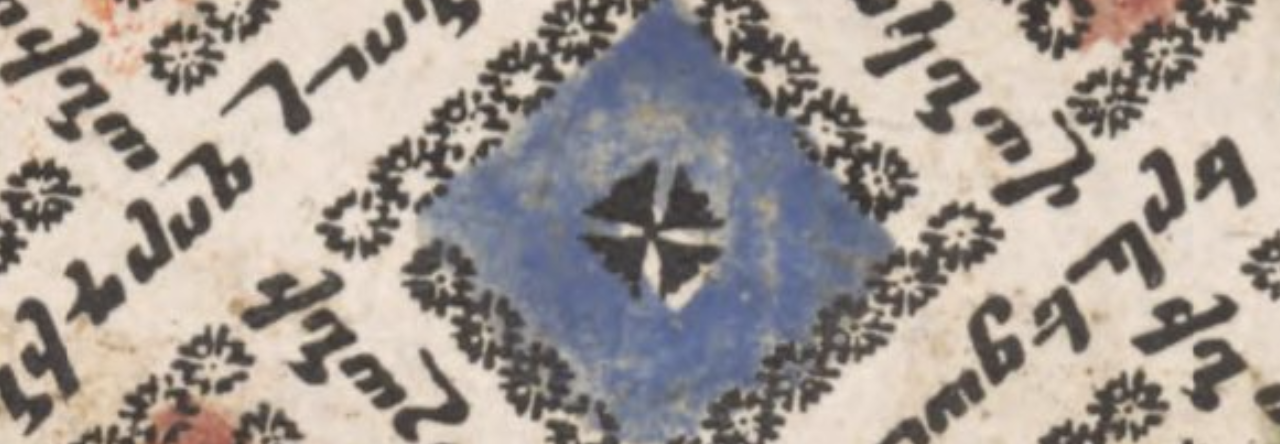
A hmayil is a handwritten or printed scroll containing prayers, supplications, Psalms, Gospel passages, hymns, and incantations. These scrolls, often richly illustrated, were a popular medium used for protection against maladies and other evils during the early modern period and were often carried or worn like a talisman. In this volume, Matthew J. Sarkisian and editor Jesse S. Arlen provide the Armenian text and an English translation of one such scroll printed in Constantinople in 1727. Together with facsimile images of the hmayil, this volume offers the reader an experience similar to unrolling and reading the original scroll. The translation is accompanied by an introduction, extensive annotation, and appendices, which bring to light the Scriptural and theological background as well as the folk and traditional characteristics of the hmayil’s texts and illustrations, making this fascinating artifact accessible to the general reader in the twenty-first century.
The publication of this volume was supported by a generous grant from Souren A. Israelyan. The book is available to purchase on Amazon.
The Zohrab Center warmly invites you to our next in-person event, a public lecture by Tamar Purut, entitled, “Frik’s Relatable Freakshow: Echoes of Faith and Endurance for Confronting Today’s Geopolitical Turmoil.” This interactive lecture will take place in Yerevan Room of the Diocesan Center on Thursday, December 12th at 7:00pm. All are welcome to attend.
Tamar Purut is a first-generation Armenian-American born and raised in New Jersey. She holds a Bachelor’s Degree in Philosophy and Political Science from Seton Hall University, a Master’s Degree in International Security from University College London, and, most recently, a postgraduate degree in Classical Armenian Studies from the University of Oxford. She is seasoned in operating anti-money laundering and compliance programs at first-tier global financial institutions and is presently an Assistant Vice President at BHI Bank. Tamar wishes to continue serving her compatriots while inspiring further discourse on what it means to be an Armenian in the diaspora while remembering and honoring her roots.
Description of Lecture: This talk will explore the life and legacy of Frik, one of Armenia’s most influential medieval poets. Through his eloquent verse, Frik captured the struggles of his time, blending profound theological reflection with poignant political commentary. His work delves into the complex relationship between faith, identity, and the ever-shifting contours of power. The presentation will examine how Frik’s writings, though rooted in the medieval Armenian experience, continue to resonate with contemporary geopolitical conflicts and questions of faith. Tamar will discuss how his reflections on the human condition and the search for divine justice offer timeless insights into the challenges we face today. This will be an opportunity to (re)discover how Frik’s poetic vision still echoes in modern debates about religion, conflict, and the pursuit of meaning in an increasingly fragmented world.
Honoring the legacy of the eponymous intellectual of the Center, a bibliography of writer, lawyer, and parlamentarian, Krikor Zohrab, who also became victim to the Armenian Genocide, has been included under the biography page of our website.
Prepared by our very own Arthur Ipek back in 2015, and recently updated, it includes works published by Zohrab in Armenian, in addition to works about his personal life and literary legacy and translations into English, French, and Turkish. Although the bibliography has been prepared in Armenian, non-Armenian works are also noted.
The bibliography is freely available to download in .pdf and .docx format.
Photograph of Krikor Zohrab, Box 3, Folder 17, Dolores Zohrab Liebmann Collection (Collection 001). ZIC Special Collections, Krikor and Clara Zohrab Information Center. Diocese of the Armenian Church of America (Eastern), New York, NY.
The recording of the conversation between Prof. George Demacopoulos with Dr. Jesse S. Arlen and Matthew J. Sarkisian on their book Odes of Saint Nersess the Graceful: Annotated Translation (New York, NY: Tarkmaneal Press, 2024) is now available to view on YouTube.
The Zoom webinar was hosted by the Orthodox Christian Studies Center of Fordham University and co-sponsored by NAASR and the Zohrab Information Center.
On Sunday, May 19th at 1:00pm after Pentecost Badarak at St. Vartan Cathedral, Dr. Jesse Arlen, director of the Diocese’s Zohrab Center, and Matthew Sarkisian, a self-taught translator of Classical Armenian from the Binghamton, NY area, will present their recently released book, Odes of Saint Nersess the Graceful: Annotated Translation (New York, NY: Tarkmaneal Press, 2024), a translation and study of 60 hymns by Catholicos Nersess. Copies of the book will be available at the event for sale, and a book signing will follow.
St. Nersess the Graceful (Nersēs Shnorhali, 1102–1173 A.D.), catholicos from 1166 until his death in 1173, was one of the great figures of the medieval Armenian Church. His most popular work is the prayer of twenty-four stanzas commonly known as “With Faith I Confess” (Havadov Khosdovanim), which has been translated into more than thirty languages. He was also a prolific author and composer of hymns and other poetic works, many of which remain little known today. This volume presents the Armenian text and an English translation of sixty of St. Nersess’s liturgical odes (tagh), fifty-eight of which have never been previously translated into English. These profound songs of praise were composed to enhance the celebration and reflect on the mystery of the various feasts and commemorations that make up the Christian liturgical year. The translation is accompanied by an introduction and extensive annotation, which brings to light the Biblical, theological, and poetic features of these literary treasures, making them accessible to the general reader in the twenty-first century.
About the Authors
Jesse S. Arlen is the director of the Krikor and Clara Zohrab Information Center at the Diocese of the Armenian Church of America in New York and a postdoctoral research fellow at the Orthodox Christian Studies Center of Fordham University. He has published a number of studies on medieval Christian spirituality and literature.
Matthew J. Sarkisian is a self-taught translator of Classical Armenian who lives in the Binghamton, New York area. He previously collaborated with Jesse Arlen on an annotated translation of an Armenian prayer scroll (hmayil), published in 2022 by the Krikor and Clara Zohrab Information Center.
About the Press
Tarkmaneal Press was founded in 2024 by Matthew J. Sarkisian and Jesse S. Arlen with the goal of bringing bilingual editions of classical Armenian texts with annotated English translations available to a wide audience. Sarkisian is a self-taught translator of Classical Armenian who lives in the Binghamton, New York area. He previously collaborated with Jesse Arlen on an annotated translation of an Armenian prayer scroll (hmayil), published in 2022 by the Krikor and Clara Zohrab Information Center. Arlen is the director of the Krikor and Clara Zohrab Information Center at the Eastern Diocese of the Armenian Church of America, and a postdoctoral research fellow at the Orthodox Christian Studies Center of Fordham University. He has published a number of studies on late antique and medieval Christian spirituality and monastic literature.
Praise for the Volume
“St. Nersess Shnorhali, Nersess the Graceful, belongs to the rank of those Church Fathers and Doctors who rightfully can be declared “the lyre of the Holy Spirit.” One of the earliest European Armenologists, the Jesuit Fr. Jacques Villote, admiring the sublime touches of heavenly inspiration emanating from Shnorhali’s verses, called his poetic masterpiece — named in Armenian Յիսուս, Որդի (Jesus, Son) from its incipit — “The Divine Elegy.” Nersess Shnorhali is one of the most exceptional figures in the history of the universal Church for more than one reason, but above all for his passionate search for the unity of the Church, and for his deep understanding, in the wake of St. Gregory of Narek, of the fragility, the conventionality, the inadequacy of human language in speaking of Divine mystery. The Odes in this volume, masterfully translated and commented upon by Matthew J. Sarkisian and Jesse S. Arlen, are among the most vibrant, genuine, and touching expressions of Shnorhali’s spirituality.”
— Abp. Levon Zekiyan, Emeritus Professor of Armenian Studies, Ca’ Foscari, Venice, and the Pontifical Oriental Institute, Rome
“St. Nersess Shnorhali’s hymns are known for their literary beauty and spiritual sublimity. Sarkisian and Arlen convey both aspects in their mellifluous translation. The substantial annotation they provide further defines their mastery of the classical text.”
— Abraham Terian, Emeritus Professor of Armenian Patristics and Theology, St. Nersess Armenian Seminary
“Thanks to Jesse Arlen and Matthew Sarkisian for this carefully prepared labor of love and learning. They have curated for us a trove of lesser-known, spiritual gems from the vast storehouse of St. Nersess Shnorhali’s writings.”
— Roberta Ervine, Professor of Armenian Christian Studies, St. Nersess Armenian Seminary
On Monday, April 15th at 4:00pm ET, authors Jesse S. Arlen and Matthew J. Sarkisian will discuss their new book, Odes of Saint Nersess the Graceful: Annotated Translation, in conversation with Prof. George Demacopoulos. The Zoom webinar is hosted by the Orthodox Christian Studies Center of Fordham University and co-sponsored by NAASR and the Zohrab Information Center.
A collection of hundreds of documents relating to the Armenian Cause including articles, letters, unpublished genocide survivor’s memoirs, exhibition catalogs, booklets, pamphlets, and ephemera has recently been processed and is now available for the interested public to view at the Zohrab Information Center. The materials in this collection relate first and foremost to the genocide of 1915, but also include materials related to the Soviet and post-Soviet Republic of Armenia, especially Nagorno-Karabakh (Artsakh). The collection was processed by Linda Smith, a graduate student at Simmons University, pursuing a degree in Archives Management, who is concurrently an archival intern at the Zohrab Center.
Photocopies of the first four pages of Yervant “Edward” Alexanian’s memoir Forced into Genocide: Memoirs of an Armenian Soldier in the Ottoman Turkish Army. Photocopies of the original materials were donated by his daughter and the memoir’s editor Adrienne Alexanian. This donation is held in boxes 6 and 7 of this collection.
The materials in the collection span over 100 years, originating from the end of the 19th century through 2022. These items were acquired and donated over the years by various individuals.
Panoramic view of Sivas, the Armenian quarter of Alexanian’s birthplaceAdrienne made notes like this one on several documents, so researchers can quickly gather details on a particular resource and its significance.
The collection’s first series is comprised of memoirs and accounts of survivors of the genocide. Most of these accounts are unpublished and unknown to both scholars and the general public, while some like Yervant Alexanian’s Forced into Genocide or Hagop Vartanian’s My Story were only published in English translation (while this collection at the Zohrab Center includes the handwritten Armenian original).
Alexanian at three different points in his military career. In the top photo, he is a new conscript in the Ottoman Turkish Army; in the middle photo, he is a new graduate of the Harbiye Military Academy; in the bottom photo, he is a second lieutenant.
Scans from the family history and diary of Hagop Vartanian, which was eventually translated and published in English by Dr. Roberta Ervine under the title My Story: Hagop Vartanian (1873–1950), Genocide: A Father’s Struggle from the United States.
These memoirs are handwritten (or, in one case, photocopies of handwritten and primary source documents) or typed on a typewriter/computer, with several survivors having pasted their own family photos within these materials.
A 1989 memoir entitled “My Name is Avak and I Survived The Armenian Holocaust of 1915: How a Young Boy, Avak Takeljian and His Family Became the Victims”.
This series in the collection provides precious new sources for genocide historians and the interested public alike, each one a testament both to the similarities in experiences of Armenian Genocide survivors while also highlighting the unique journeys of the various individuals and families during and after the tragedy.
Among those individuals is Zaven Seraidarian with his six bound volumes of handwritten notes, memories, poetry, drawings, and scrapbooked images.
“Left to Right: Zaven, Mari, Mihran Seraidarian. We are witness to 1915.”“Zaven Seraidarian – I was born in the Putania [Bithynia] region of western Asia Minor, Nicomedia, the town of Geyve, Kaylaplour [Wolf-Hill] or, in translation, the Turkish name Ghurtbalan or Kurtbelen, Turkey.”“Mihran – Zaven Seraidarian, two brothers, scions of a patriarchal family. We are witness to the two and a half million martyrs. Whoever reads this story of a bloody journey – we remain living in this world. Whoever does not read this story of a bloody journey – that is when we two brothers will be dead to this world.”“Springtime Teardrops – The world belongs to the powerful, may God take our vengeance upon our enemies – You must be sacred hearts in the world – H. T., M. M., Z. S.”“To the Armenian who speaks in a foreign language, always respond in Armenian.”
Seraidarian shares a mix of materials, including personal memories and emotions from his experiences of the First World War and the Armenian Genocide, expressed both in the contents of his writing and the various forms they take in the volumes.
He includes photographs of himself, as well as other images, and writes about the legacy of the Armenians of what is today the north-west of Turkey, historically known as Putania (Բիւթանիա) or Bithynia. Seraidarian was from an area by the town of Geyve near the major city of that region, Nicomedia (modern Izmit).
Seraidarian’s writings are repetitive, often dwelling on the horrors he witnessed and experienced, replete with longing for justice for himself and the Armenian people. Our current generation may assess his volumes as manifestations of journaling, or efforts to work through the traumas that so deeply afflicted his life.
The second series covers community and political activism, which includes documentation of worldwide efforts to raise awareness of the genocide, as well as more contemporary struggles involving Soviet Armenia, the Republic of Armenia, and Nagorno-Karabagh (Artsakh). This is the largest series, including articles, conference reports, and booklets. Materials from government subcommittees and from the House of Representatives and Senate show efforts to recognize April 24 as the National Day of Remembrance of Man’s Inhumanity to Man and hold Turkey accountable for its actions during and after the genocide.
An informational flyer that contains historic information about Armenia in general and the genocide.
The third series contains historical and informational documents. These are materials that provide background information about Armenia and the genocide, both from historical and contemporary points of view, often meant to influence public opinion, raise awareness, or educate younger generations.
A spread from a 1980 booklet entitled “Sauver ce qui peut encore être sauvé…les monuments arméniens de Turquie” (“Save what can still be saved…the Armenian monuments of Turkey”).
The final series contains materials from memorial events and exhibitions that took place in commemoration of the genocide. The booklets and articles in this series provide a comprehensive picture of how Armenians around the world have continued to remember and speak about the Armenian Genocide and its aftermath, as well as educate the general population through sharing stories and art.
A booklet for an art exhibition entitled “Absence Presence: The Artistic Memory of the Holocaust and Genocide”, which was held at the Katherine E. Nash Gallery at the University of Minnesota from January 7-February 25, 1999.
This collection brings together a wide array of mostly unpublished materials related to the Armenian Cause in general and the genocide in particular, including unpublished and previously unknown survivor accounts. This collection also highlights the efforts of Armenians and their allies the world over to remember the tragedy, honor the Armenian people, hold the Turkish government accountable, and share their experiences through the arts and community engagement.
A scan of H.R. 191, a bill passed in the Texas House of Representatives officially recognizing the Armenian Genocide. This resolution passed in 2017.
This collection is now available for visitors who want to research the genocide and learn more about past and present efforts related to genocide remembrance and activism for the Armenian Cause. A searchable finding aid of the collection is available to view here.
Please join us for the launch of our second annual monthly reading series, Literary Lights 2024, featuring Tölölyan Literary Prize recipient Aida Zilelian, author of All the Ways We Lied. Zilelian will be joined by Nancy Agabian, author of Princess Freak (2000), Me as Her Again: True Stories of an Armenian Daughter (2008), and the PEN/Bellwether Prize for Socially Engaged Fiction finalist, The Fear of Large and Small Nations (2023). The event will take place on Zoom on January 27, 2024 at 12:00 PM Eastern (Register here).
Literary Lights is a monthly reading series organized by the International Armenian Literary Alliance (IALA), the National Association for Armenian Studies & Research (NAASR), and the Krikor and Clara Zohrab Information Center. Each event—held online—will feature a writer reading from their work, followed by a discussion with an interviewer and audience members. Keep an eye on our website and socials for the exact dates of each event. Click here to read along with the series by purchasing titles from IALA’s online bookstore powered by Bookshop or the NAASR bookstore.
Set in Queens, New York, while a father deteriorates from terminal illness, three sisters contend with one another, their self-destructive pasts, and their indomitable mother as they face the loss of the one person holding their unstable family together.
Kohar, the oldest sister, is happily married, yet grapples with fertility issues and, in turn, her own self-worth. Lucine, the middle child, is trapped in a loveless marriage and haunted by memories of her estranged father. Azad, the beloved youngest child, is burdened by an inescapable cycle of failed relationships.
By turns heartfelt and heart-wrenching, All the Ways We Lied introduces a cast of tragically flawed but lovable characters on the brink of unraveling. With humor and compassion, this spellbinding tale explores the fraught and contradictory landscape of sisterhood, introducing four unforgettable women who have nothing in common, and are bound by blood and history. Learn more about the novel.
Aida Zilelian is a first generation American-Armenian writer, educator and storyteller from Queens, NY. She is the author of The Legacy of Lost Things, recipient of the Tololyan Literary Award. She has been featured in the Huffington Post, NPR’s Takeaway, Poets & Writers, Kirkus Reviews, among other media and print outlets. Her short story collection These Hills Were Meant for You was shortlisted for Katherine Anne Porter Prize in Short Fiction. Zilelian was the curator of Boundless Tales, one of the first and longest-running reading series in Queens, NY, which she recently revived. She is on the Board of Directors of Newtown Literary, a Queens-based literary journal that supports emerging writers, and a IALA Advisory Board member. All the Ways We Lied is her second published novel.